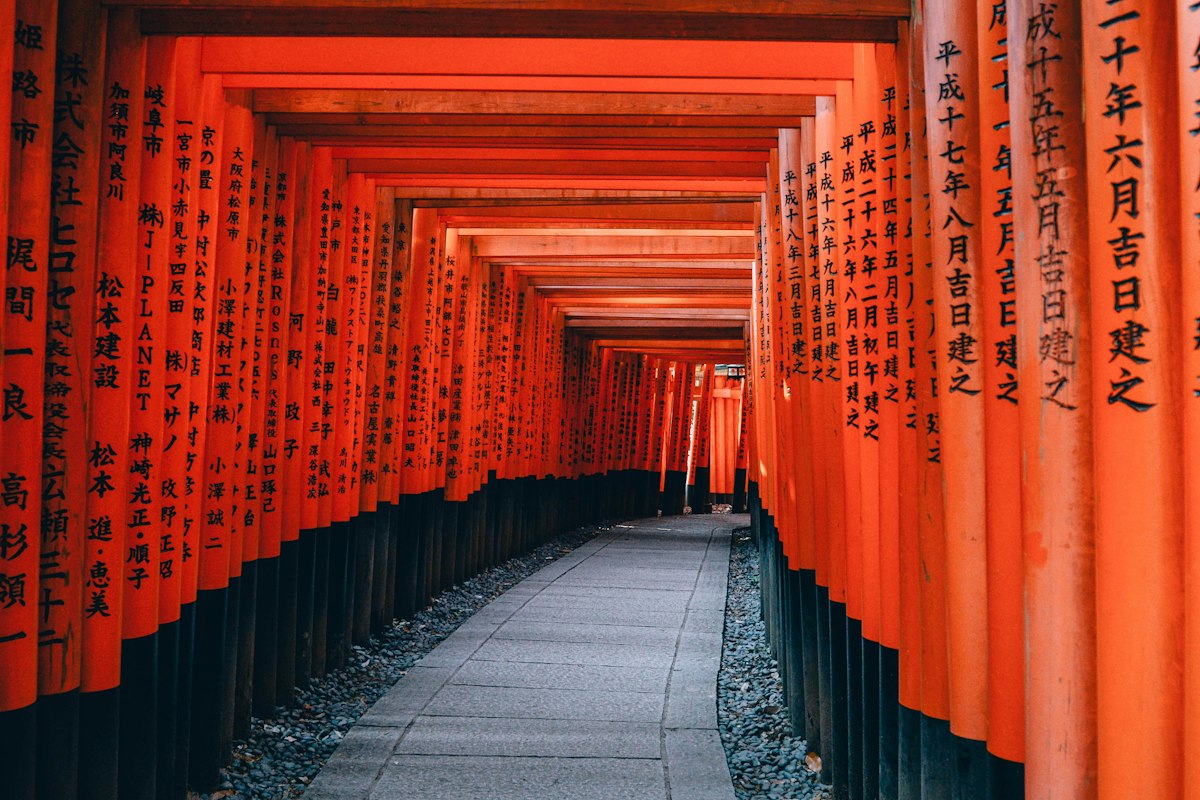
Japan’s Shinto shrines are among the most atmospheric places on earth for a couple to visit — ancient forest settings, the scent of cedar and incense, the sound of a distant bell, and a spiritual tradition that has been celebrating love and human connection for over a thousand years. For honeymooners, Japan offers something that no other country can: shrines specifically dedicated to en-musubi (縁結び), the tying of bonds between people, where newlyweds can offer a prayer and receive a blessing for their new life together.
This guide covers Japan’s best shrines for a honeymoon, chosen for spiritual significance, beauty, accessibility, and the quality of the experience for couples. We also include practical summer tips, since many honeymooners visit Japan in June through August.
1. Izumo Taisha — Japan’s Ultimate Shrine for Marriage
Location: Izumo, Shimane Prefecture

Why it matters: Izumo Taisha is Japan’s undisputed #1 shrine for en-musubi — the tying of all human relationships, most particularly marriage. The deity enshrined here, Okuninushi no Mikoto, is the god who presides over all bonds between people. According to tradition, every October the gods of Japan gather at Izumo Taisha to arrange the marriages of all people for the coming year — which is why October is called Kannazuki (month without gods) everywhere else in Japan, but Kamiari-zuki (month with gods) in Izumo.
For couples: Receiving a en-musubi amulet here is considered the most powerful marriage blessing in Japan. Many couples also tie en-musubi paper charms (ema) to the rack at the main hall. The shimenawa (sacred rope) above the Kagura-den is the largest in Japan — standing beneath it together is a deeply memorable moment.
Practical tips:
- Allow a full half-day — the main hall, rabbit statues (Okuninushi’s sacred animals), and the coastal road to Inasanohama beach all deserve time
- Summer access: Fastest from Osaka/Kyoto by Sanin express train via Tottori, or fly to Izumo Airport (45 min from Osaka by JAL). The shrine is 20 min by bus from Izumo-shi Station.
- Summer note: June and July mornings are cool and mist-covered — arrive before 9am for the most atmospheric experience
- Combined with: Matsue city (30 min) — castle, old town, and Adachi Museum of Art (Japan’s most beautiful garden)
2. Itsukushima Shrine — The Floating Torii
Location: Miyajima Island, Hiroshima Prefecture

Why it matters: Itsukushima is one of Japan’s three official “views of great beauty” (nihon sankei) and a UNESCO World Heritage Site. Its vermillion O-torii gate rises from Hiroshima Bay, appearing to float on the water at high tide — one of the most photographed and genuinely breathtaking sights in Japan. For couples, the combination of sea, island, shrine, and mountain creates an atmosphere of complete remove from everyday life.
For couples: Rent a rowing boat at high tide and approach the O-torii from the water — the perspective is completely different from the shore and deeply romantic. At sunset, the shrine and gate glow orange-red against the darkening sea. Night illuminations run year-round.
Practical tips:
- Miyajima Island is 10 min by JR ferry from Miyajimaguchi Station (30 min from Hiroshima by JR — included in JR Pass)
- Summer note: Miyajima gets very crowded in August. Arrive by the first ferry (6:25am) or stay overnight on the island for the magical experience of the shrine after day-trippers leave
- Check tide tables before you go — the floating effect only works at high tide; at low tide you can walk out to the gate
- Combine with a Hiroshima day and the Hiroshima Peace Memorial Museum for a profoundly meaningful journey
3. Meiji Jingu — Tokyo’s Sacred Forest
Location: Harajuku, Tokyo

Why it matters: Meiji Jingu is Tokyo’s most important Shinto shrine, dedicated to Emperor Meiji and Empress Shoken — a couple known for their devotion to each other and to Japan’s modernisation. The shrine is surrounded by a 70-hectare forest of 120,000 trees donated from across Japan at its founding in 1920. Walking its forested paths is an extraordinary experience of silence and nature within the world’s largest city.
For couples: The en-musubi blessings at the main hall are popular with couples; writing wishes on ema wooden tablets together is a lovely ritual. The inner garden (Gyoen) features a beautiful iris garden that peaks in mid-June — one of Tokyo’s finest seasonal spectacles.
Practical tips:
- 5 min walk from Harajuku Station (JR Yamanote Line) or Meiji-jingumae Station (Chiyoda Line)
- Enter free; inner garden ¥500
- Summer note: The forest keeps the shrine significantly cooler than central Tokyo — ideal on hot summer days. Morning visits (7–9am) are quiet and cool
4. Fushimi Inari Taisha — Gates Without End
Location: Fushimi, Kyoto

Why it matters: Fushimi Inari’s 10,000 vermillion torii gates winding up a forested mountain are one of Japan’s most iconic and most photographed sights. The endless tunnel of gates creates a hypnotic, otherworldly atmosphere unlike anything else in Japan. The hike to the summit (2–3 hours return) rewards couples with mountain views over Kyoto and a real sense of adventure.
For couples: The upper sections of the mountain (above Yotsutsuji intersection, 30 min up) are significantly less crowded than the famous lower gates — continue upward for intimate, photogenic stretches of torii through cedar forest. The mountain is open 24 hours; a pre-dawn or post-sunset visit with lanterns lit is exceptionally romantic.
Practical tips:
- 5 min walk from Inari Station (JR Nara Line, 5 min from Kyoto Station, ¥150)
- No entry fee
- Summer note: Start before 7am to beat the heat and the crowds. The mountain can be genuinely hot and humid from 10am onwards in July-August; bring water
5. Izumo Hinomisaki Shrine — Dramatic Coastal Setting
Location: Hinomisaki, Shimane Prefecture (near Izumo Taisha)

Why it matters: Often combined with Izumo Taisha as a half-day extension, Hinomisaki Shrine sits on a dramatic promontory above the Sea of Japan — twin shrines on different levels connected by a stone staircase, surrounded by pine-covered cliffs and the sound of surf. It enshrines the sun goddess Amaterasu (the highest deity in Shinto) and the moon god Tsukuyomi — making it a deeply poetic shrine for couples, dedicated to the sun and moon together.
For couples: Sunset from Cape Hinomisaki — a 10-minute walk from the shrine — is one of the most beautiful on the Sea of Japan coast. The lighthouse (Japan’s tallest stone lighthouse, 1903) can be climbed for 360° views.
Practical tips:
- 30 min by bus from Izumo-taisha-mae Stop
- Summer note: June–August sunsets are spectacular from the cape; sunset is around 7:30pm in midsummer
6. Kasuga Taisha — Nara’s Lantern-Lit Sanctuary
Location: Nara City, Nara Prefecture

Why it matters: Kasuga Taisha, founded in 768 CE and a UNESCO World Heritage Site, is Nara’s most sacred shrine — a complex of vermillion halls in ancient forest, famous for its 3,000 bronze and stone lanterns that are lit twice a year at the Mantoro Festival. The shrine is reached through Nara Park, where over 1,000 semi-wild deer roam freely among visitors — one of Japan’s most magical and uniquely Japanese experiences.
For couples: Feed the deer together (sembei crackers available throughout the park), then walk the lantern-lined approach path through the forest to the shrine. The inner sanctum’s hanging bronze lanterns create an extraordinary golden atmosphere even in daylight.
Practical tips:
- 20 min walk from Kintetsu Nara Station or JR Nara Station through the park
- Summer note: Nara is compact and manageable in a half-day from Kyoto (45 min by Kintetsu Limited Express) or Osaka (1 hr). Mornings are best — deer are more active before the heat builds
7. Hakone Shrine — Torii in the Lake
Location: Hakone, Kanagawa Prefecture

Why it matters: Hakone Shrine’s lakeside torii gate rising from the mist-covered waters of Lake Ashi — with Mt. Fuji occasionally visible behind — is one of Japan’s most romantic shrine settings. The approach through ancient cryptomeria cedar forest, the red torii emerging from the water, and the mountain air make this a favourite for couples visiting the nearby onsen resort area.
For couples: Combining Hakone Shrine with a Lake Ashi cruise (pirate ship style) gives you the unique view of the torii from the water. An overnight ryokan stay in Hakone with rotenburo (outdoor hot spring bath) makes this a quintessential romantic Japan experience.
Practical tips:
- Access by Izu-Hakone bus from Hakone-Yumoto or by boat from Motohakone-ko pier
- Summer note: Hakone’s higher altitude (700m+) makes it significantly cooler than Tokyo — an ideal summer escape
8. Kirishima Jingu — Mythological Origin of Japan
Location: Kirishima, Kagoshima Prefecture

Why it matters: Kirishima Jingu is where Japan’s creation myth begins — dedicated to Ninigi-no-Mikoto, the grandson of Amaterasu who descended from heaven to Japan at this very spot. The shrine sits on a forested plateau amid the volcanic Kirishima mountain range, with views over southern Kyushu and a profound atmosphere of primordial Japan undisturbed by mass tourism. For a honeymoon, Kirishima combines uniquely with Ibusuki’s sand baths and the dramatic Sakurajima volcano nearby.
For couples: The surrounding Kirishima mountains offer hiking trails through volcanic highland dotted with crater lakes — the Ebino Kogen plateau’s blue-green crater lake Rokkannon Midaike is especially beautiful in summer. The nearby Kirishima onsen ryokan district has some of southern Japan’s finest hot springs.
Practical tips:
- Access by bus from Kirishima Jingu Station (JR Nippo Line, 45 min from Kagoshima-Chuo by limited express)
- Summer note: The plateau at 1,200m is refreshingly cool even in August
Summer Honeymoon Shrine Tips
Timing:
- Early morning is essential — arrive at any famous shrine before 9am. The atmosphere, temperature, and crowd level are all dramatically better
- Fushimi Inari and Meiji Jingu are particularly magical at dawn
- June is Japan’s tsuyu (rainy season) — shrines in mist and rain are extraordinarily atmospheric; bring a clear umbrella for beautiful wet-shrine photography
Shrine etiquette for couples:
- Purify both hands at the temizuya (purification basin) before approaching the main hall
- At the main hall, bow twice, clap twice, make your prayer together, bow once more (nirei nihaku ichirei)
- When buying o-mamori (amulets) as a couple, the en-musubi amulet (縁結びお守り) is specifically for relationships — one for each of you
What to buy as a couple:
- En-musubi ema (wooden wish tablet) — write your wish together and hang it at the shrine
- En-musubi o-mamori — pair amulets for the couple
- At Izumo Taisha specifically: the shimenawa amulets are considered the most powerful en-musubi objects in Japan
Suggested Honeymoon Itineraries
7 nights — Classic + Izumo
- Tokyo 2 nights (Meiji Jingu)
- Kyoto 2 nights (Fushimi Inari, day trip to Nara/Kasuga Taisha)
- Hiroshima/Miyajima 1 night (Itsukushima Shrine)
- Izumo/Matsue 2 nights (Izumo Taisha, Hinomisaki)
5 nights — Kyushu Romance
- Fukuoka 1 night (base)
- Kagoshima 2 nights (Kirishima Jingu, Ibusuki sand bath)
- Nagasaki or Beppu 2 nights
10 nights — Comprehensive
- Tokyo 2 nights → Hakone 1 night (Hakone Shrine + ryokan) → Kyoto 3 nights → Hiroshima/Miyajima 1 night → Izumo 2 nights → Osaka 1 night
Frequently Asked Questions
Q: Which shrine is best specifically for marriage blessings? Izumo Taisha is unambiguously Japan’s #1 shrine for marriage and relationships. Every other shrine’s en-musubi blessings are considered secondary to Izumo’s. If you can visit only one, make it Izumo.
Q: Is June (rainy season) a bad time for a shrine honeymoon? Not at all — rainy season shrines are extraordinarily beautiful. Moss turns vivid green, mist hangs in forest paths, and crowds thin dramatically. Bring a quality clear umbrella (sold everywhere in Japan for ¥500–¥1,000) and embrace it.
Q: Can we have a Shinto ceremony at any of these shrines? Yes — most major shrines offer sanzen (wedding blessings) and some host full Shinto wedding ceremonies (shinzen shiki). Meiji Jingu and Izumo Taisha are particularly well-known for this. Contact the shrine office well in advance (and a wedding coordinator if you don’t read Japanese).
Q: Are the shrines accessible without a car? All shrines in this guide are accessible by public transport. Izumo Taisha and Kirishima Jingu require the most travel; the others (Kyoto, Tokyo, Nara, Hiroshima, Hakone) are straightforward from major hubs.
Q: What should we wear to shrines in summer? There is no dress code at most Shinto shrines. However, modest, respectful clothing is appreciated — avoid very short shorts or revealing tops at the main hall. Light, breathable fabric is practical in summer heat.