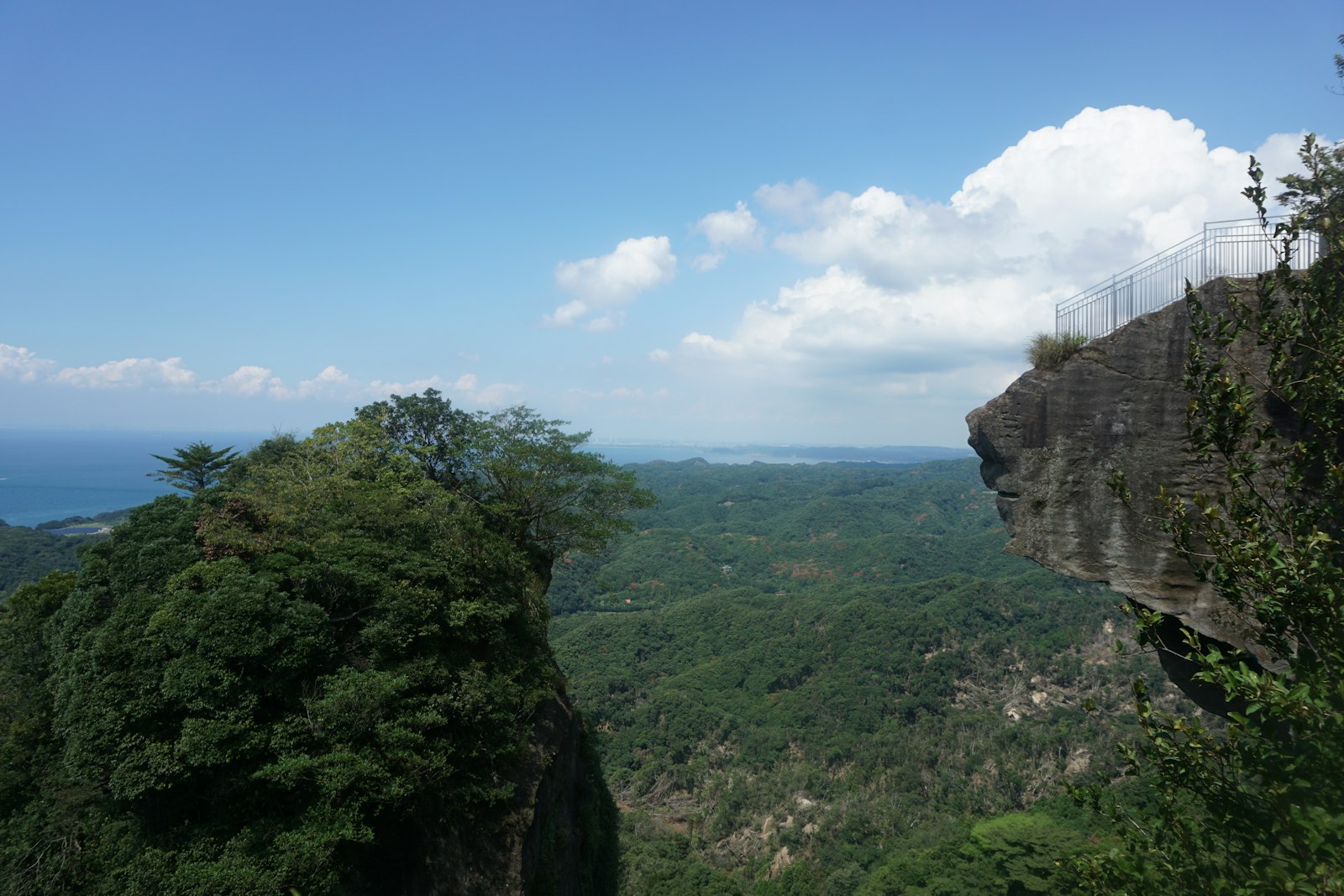
Most visitors to Chiba pass through Narita Airport, board a train to Tokyo, and never return. Some stop at Tokyo Disney Resort and go no further. But Chiba extends far beyond its airport and theme park — south along the Boso Peninsula, east to the lighthouse at the Pacific edge, and into an interior of forested gorges, rural railways, and fishing villages that have changed very little since the Meiji era. These are the places that reward the traveller willing to spend a little more time.
Shimizu Gorge and Kameiwano Cave — The Heart in the Mountain
Of all the natural formations in the Kanto region, the Kameiwano Cave in the Kimitsu mountains of southern Chiba is among the least known and most visually extraordinary. The Shimizu River has carved a perfectly circular opening in the cliff, approximately 2 metres in diameter, through which the water passes. In the early morning during spring and autumn, sunlight enters the circular hole at an angle that produces a glowing heart-shaped reflection in the pool below — the arch of the circle, mirrored in the water, creates a symmetrical heart that lasts for about two hours as the light moves.
The sight has been widely photographed since approximately 2015 but remains almost entirely unknown to international visitors. The access is straightforward — a short walk from the roadside car park — but requires either a car or a taxi from Kimitsu Station. There are no facilities, no entrance fees, and no vendors. You arrive, experience it, and leave. The gorge is beautiful at any time of year, not only when the heart reflection is visible.
Best timing for the heart reflection: Mid-February to mid-March, 9:00–11:00 AM. Also October, similar hours. The exact dates shift slightly each year with weather conditions.
Access: By car, approximately 30 minutes from Kimitsu IC on the Kisarazu-Futtsu Road. Or JR Uchibō Line to Kimitsu Station, then taxi approximately 20 minutes.
Cape Inubosaki — Lighthouse at the Pacific Edge
Where the Tone River meets the Pacific and the Kuroshio current flows north along the Kanto coast, Cape Inubosaki juts into the sea as the northeastern corner of Chiba. The stone lighthouse here — built in 1874 by British engineer Richard Henry Brunton, who designed eight Japanese lighthouses during the Meiji era — stands on a cliff above the confluence of ocean currents that makes these waters among the most fertile fishing grounds in Japan.
The cape has a windswept, elemental quality that distinguishes it from more visited headlands. The rocks below the cliff are carved into dramatic formations by the competing currents. In winter, the air is cold and clear enough to see the coast of Ibaraki stretching north, and on the clearest days the mountains of the Kanto interior are visible to the west. Almost no international tourists come here.
The nearby Inubosaki Shiraiwa Hotel has a clifftop outdoor bath with an unobstructed view of the Pacific — one of the most dramatically sited rotenburo (outdoor baths) in the Kanto region. The whale watching boats operating from Choshi port depart from a harbour a few kilometres south of the cape.
Access: JR Sobu Line limited express to Choshi, then taxi approximately 15 minutes, or local bus (infrequent — check schedule).
Tateyama and the Boso Old Towns
Tateyama at the southern tip of the Boso Peninsula is the main city of the Boso south, and it carries remnants of its Edo-period merchant town status in the old quarter near the castle hill. The reconstructed Tateyama Castle keep on the hill above the city is modest, but the view from its top — the Pacific visible on three sides with the Sagami Bay to the northwest — is worth the 20-minute walk up from the station.
The inland towns of Otaki and Isumi preserve Edo-period merchant architecture along their main streets, with traditional wooden shopfronts, whitewashed storehouses, and the particular quiet of places that tourism has not yet reached. Otaki Castle, high above the town on a forested ridge, has views across the agricultural Boso interior that are rarely photographed. The pace in these towns is genuinely slow.
Access: JR Sotobo Line for Isumi area; JR Uchibō Line for Tateyama and Otaki.
Isumi Railway — Japan’s Most Beautiful Spring Rural Line
Between late March and mid-April, the Isumi Railway’s single-track line through the agricultural centre of Chiba becomes one of Japan’s most beautiful train journeys. The railway dates from 1937 and has never been modernized beyond safety requirements — the diesel railcars are old, the stations are small, and the schedule runs at an hour-by-hour pace that requires planning. In spring, this apparent disadvantage becomes its greatest asset: the contrast between the aged, unhurried train and the violent explosion of yellow rapeseed and pink cherry blossoms on both sides creates images that feel timeless.
The line is genuinely rural — the stations serve farming villages and have no amenities beyond a small waiting shelter — and the population of photographers who line the embankments during blossom season is its own kind of spectacle. But outside cherry season, the Isumi Railway is simply a quiet country train through farmland, worth riding for the contemplative pace and the view of a Chiba that the highways and expressways bypassed entirely.
Access: JR Sotobo Line to Ohara, then Isumi Railway. Full run to Kazusa-Nakano takes about 55 minutes.
Yoro Valley — The Gorge Most Tokyo Residents Have Never Heard Of
Ask a hundred Tokyo residents about the Yoro Valley and perhaps ten will know it exists. The narrow forested gorge cut by the Yoro River through the hills of central Chiba has traditional ryokan, a riverside walking path, autumn foliage of exceptional quality, and an atmosphere of complete quiet that the more famous gorge towns of Gunma or Yamanashi no longer provide.
The appeal is precisely its obscurity. The path along the gorge bottom takes under an hour to walk and passes through sections where the cliffs press in on both sides and the river runs fast over smooth stone. The autumn foliage here peaks in mid-November, slightly later than the forests further north, and the colours on the cliff walls above the river — gold, amber, deep red against the grey rock — are as fine as anything in the Kanto region.
Access: JR Uchibō Line to Goi, then Kominato Railway to Yorokeikoku Station. Or by car via the Aqualine (approximately 90 minutes from central Tokyo).
Practical Tips
Car access: Kameiwano Cave, the Boso Flower Line, and the southern cape areas are genuinely difficult without a car. The Aqualine (Tokyo Bay Aqua-Line toll: ¥800) is fast and makes the southern peninsula accessible as a day trip. Rental cars are available at Kisarazu IC and at major Boso stations.
Combining hidden gems: A two-day Boso itinerary might look like this: Day 1 — Kameiwano Cave (morning), Tateyama old town (lunch), Boso Flower Line walk at Cape Shirahama (afternoon), overnight at a Minamiboso ryokan. Day 2 — Morning coastal walk, drive north via Kamogawa to the Isumi Railway for the afternoon, return to Tokyo via the Aqualine.