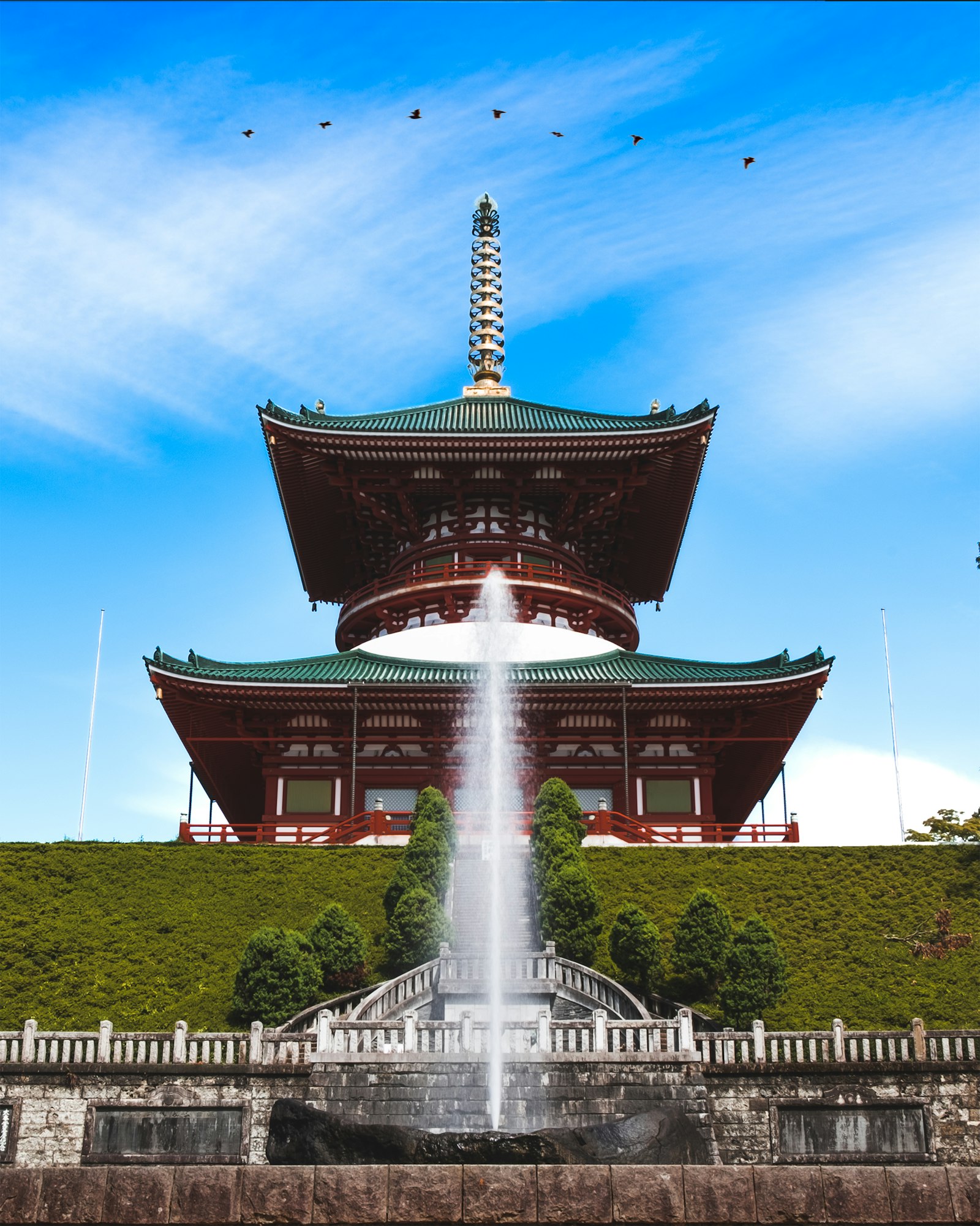
Chiba wraps around the east side of Tokyo Bay and extends far into the Pacific, forming a prefecture that most international visitors enter — through Narita Airport — and immediately leave. That is a mistake. Within Chiba’s borders you will find one of Japan’s most-visited Buddhist temples, a cliff-face Buddha larger than the one at Nara, a coastal town that turns its stone staircases into a river of traditional dolls each spring, and a forested gorge whose cave produces one of Japan’s most photographed natural phenomena. The prefecture rewards anyone willing to slow down.
Naritasan Shinshoji Temple
Naritasan Shinshoji is one of the most visited temples in Japan, drawing over twelve million worshippers and tourists each year — yet it sits just fifteen minutes' walk from Narita Airport and remains almost unknown to the international travellers who fly directly above it. The temple was founded in 940 AD following the suppression of a regional rebellion, and its main deity is Fudo Myoo — a fierce protective figure depicted surrounded by flames, holding a sword and a rope to bind evil. Prayers here focus on traffic safety, business success, and the warding off of misfortune.
The complex is far larger than most visitors expect. The main hall (Daikondo) is ringed by pagodas, incense burners, and smaller halls spread across a forested hillside. Behind the main hall, a spacious park descends through manicured gardens, ponds, and narrow stone paths to a series of smaller sub-temples. Allow at least ninety minutes to walk the full grounds, and save time for the approach road — the Omotesando — which is lined for 800 metres with traditional restaurants, most of them specializing in grilled unagi (eel) that has been a local institution for over two centuries.
Access: Narita Station (Keisei or JR), then 15 minutes on foot. ¥0 entry to temple grounds. Open daily.
Nokogiri-yama — Cliff Buddha and Tokyo Bay Views
Nokogiri-yama (literally “sawtooth mountain”) rises above the western Boso Peninsula with a jagged ridgeline visible from Tokyo Bay ferries. The mountain takes its name from the serrated silhouette produced by centuries of quarrying operations that extracted sandstone for Tokyo’s Meiji-era construction projects. What the quarrying left behind is a dramatic landscape of vertical rock faces, carved pathways, and dramatic overhangs — and, at the mountain’s heart, one of the largest Buddhist sculptures in Japan.
The Nihonji Temple complex covers the entire mountain, and its star attraction is the Hyakushaku Kannon — a 31-metre relief carving of the Kannon bodhisattva cut directly into the vertical cliff face. Nearby, a separate viewpoint called Jigoku Nozoki (Hell’s Peek) projects over a sheer drop with sweeping views of Tokyo Bay, the Miura Peninsula, and on clear winter days, Mt. Fuji rising behind the Tanzawa range. The sight of visitors gripping the railing at the very edge while the bay glitters several hundred metres below is memorable.
The mountain can be reached by ropeway from the Hamakanaya side, or climbed on foot via stone steps from the Nokogiri-yama exit of the Uchibō Line. The full temple circuit takes two to three hours. Entry to the temple grounds costs ¥700.
Access: JR Uchibō Line to Hamakanaya Station, then ropeway (¥1,480 round trip) or on foot (30 min ascent).
Katsuura — Japan’s Most Spectacular Hinamatsuri
In early March, the coastal town of Katsuura transforms its central stone staircase into one of the most striking festival displays in Japan. Over 30,000 traditional hina dolls are arranged on the steps leading up to Tomisaki Shrine — tier upon tier of silk-clad court figurines cascading down the hillside in a river of red and gold. The Katsuura Hinamatsuri runs for several days in late February and early March and draws visitors from across the Kanto region.
Outside festival season, Katsuura is worth visiting for its morning fish market, which opens to the public and offers some of the freshest sashimi in the prefecture. The market handles significant quantities of bluefin tuna and bonito from the offshore Pacific fishing grounds, and it is possible to buy directly from the stalls and have your purchase prepared as sashimi at the adjacent restaurant sheds for a nominal preparation fee.
Access: JR Sotobo Line to Katsuura Station. The hina doll display is on the staircase near Tomisaki Shrine, a short walk from the station.
Shimizu Gorge — The Heart Cave (Kameiwano Cave)
Hidden in the Kimitsu mountains in southern Chiba, the Shimizu River has carved a remarkable formation known locally as Kameiwano Cave: a perfectly circular opening in the cliff through which the river flows. In the early morning during spring and autumn, sunlight enters the circular hole at precisely the right angle to create a glowing heart-shaped reflection on the water below. The image — a luminous heart framed by mossy rock — has become one of the most widely shared photographs of any natural site in the Kanto region.
The cave and the Nokimizo Falls are accessed by a short trail from the parking area. The heart reflection is most pronounced from mid-February to mid-March (morning light from 9–11am) and again in October. The gorge is peaceful at any time of year, with clear mountain water, forest atmosphere, and complete absence of tourist infrastructure. There are no entrance fees and no facilities — bring water and suitable footwear.
Access: By car from Kimitsu City (approximately 30 minutes from Kimitsu IC on the Kisarazu-Futtsu Road). Public transport access is limited; a car is strongly recommended.
Yoro Valley Onsen (Yorokeikoku)
The Yoro River cuts a narrow gorge through the forested hills of central Chiba, and at the bottom of the valley the old spa town of Yorokeikoku has been welcoming visitors since the Meiji era. This is not a well-known destination — it has no shinkansen access and no famous temple — but the combination of forested gorge, autumn colour, and traditional ryokan overlooking the river is among the most quietly beautiful in the entire Kanto region.
Several ryokan in the valley have open-air baths positioned directly above the river, where the sound of the water fills the steam and the forest canopy closes overhead. The autumn foliage season (mid-November) turns the gorge walls gold and amber. A short walking trail follows the river through the narrowest section of the gorge, where the cliffs come within a few metres of each other on either side.
Access: JR Uchibō Line to Goi Station, then Kominato Railway to Yorokeikoku Station (approximately 2 hours from Tokyo). A car from Tokyo reaches the valley in about 90 minutes via the Aqualine.
Practical Tips
Combining sites: Naritasan and a Narita Airport arrival or departure combine naturally — the temple is 15 minutes from the airport. Nokogiri-yama fits well with a Tokyo Bay ferry crossing (Kurihama–Hamakanaya, about 40 minutes). Shimizu Gorge and the southern Boso coast are best explored by car on a single extended day trip.
Best seasons: The Katsuura Hinamatsuri runs in late February to early March. Shimizu Gorge’s heart reflection is best in mid-February to mid-March and again in October. Yoro Valley peaks in autumn foliage (mid-November). Naritasan and Nokogiri-yama are worth visiting year-round.
Crowds: Naritasan is busiest at New Year (January 1–3), Setsubun (early February), and at cherry blossom time. Early weekday mornings are noticeably quieter at all sites listed here.