HAUNTED SPOTS AND ATMOSPHERIC LOCATIONS OF FUKUSHIMA PREFECTURE
Visitor Guidelines
Before exploring any historically significant or sensitive sites in Fukushima Prefecture, please observe these essential guidelines:
- Respect memorial sites as you would any war grave. Iimori Hill and the Tsurugajo area carry real historical suffering. Behave with the seriousness these places deserve.
- The former nuclear exclusion zones have specific access rules. Some areas within the former evacuation zone are now open; others remain restricted. Always check current status with local authorities before visiting any area near Okuma or Futaba. Do not enter fenced or clearly marked restricted areas.
- The Adachigahara cave site is managed for tourism. Follow marked paths and respect private land adjacent to the trail.
- Visit atmospheric locations during daylight hours for safety. Many historical sites are isolated, poorly lit after dark, and structurally uneven.
- Leave no trace and remove all rubbish. Do not disturb markers, graves, or offerings.
IIMORI HILL: THE WEIGHT OF A WRONG DECISION
Historical Weight
On September 22, 1868, nineteen boys between 16 and 17 years old climbed to the summit of Iimori Hill as the Battle of Aizuwakamatsu reached its crisis. They were members of the Byakkotai (White Tiger Brigade), Aizu’s youngest samurai cohort, retreating through smoke and chaos after their unit was separated from the main defense.
From the hilltop, they looked toward Tsurugajo Castle—or rather, toward where it should have been visible through the smoke and haze. What they saw—or believed they saw—was the castle burning. Raised in a culture that understood surrender as a form of death more final than death itself, and believing their lord’s stronghold had fallen, eighteen of the boys committed ritual suicide on the hillside. One boy—Iinuma Sadakichi—lost consciousness before completing the act and was found alive by a local woman who nursed him back to survival.
The castle had not fallen. The burning they saw was the castle town—the merchant and artisan districts that surrounded the fortress. The castle held for another month. The boys died on the basis of information that was both incomplete and, in one crucial particular, wrong.
The Atmospheric Reality
The graves—simple headstones in a row, looking toward the city—accumulate offerings continuously. Not official ones, not tourist obligations, but personal items placed by ordinary Japanese visitors who feel compelled: flowers, coins, small toys, origami cranes. A grove of cedar trees surrounds the upper site, dampening sound. In the hour before sunset, when the city below is lit in gold and the castle keep is silhouetted against the horizon, the sight-line the boys had is restored—you understand exactly what they saw, from exactly where they stood.
The Sazaedo Pagoda stands nearby: a wooden structure built in 1796 featuring a double-helix staircase that allows ascent and descent simultaneously without passing another person. Its acoustic properties are unusual—voices echo in ways that suggest other presences. The combination of the grave site, the view, and this architecturally strange pagoda creates one of Japan’s most genuinely atmospheric locations.
Visiting Approach
Take the Haikara-san loop bus from Aizuwakamatsu Station. Arrive at the hill in late afternoon (4–5pm in autumn, when crowds have reduced). Climb via the mechanical walkway or the stone steps through cedar—each approach offers different psychological preparation. Sit at the hilltop for 15–20 minutes. Look toward the castle in silence. The story needs space.
TSURUGAJO CASTLE: WALLS THAT ABSORBED A MONTH OF SIEGE
Historical Weight
The 1868 siege of Tsurugajo was not a swift engagement—it lasted one month, from October to November, with the castle under constant artillery bombardment. The Meiji imperial forces possessed modern Krupp cannon while the Aizu defenders largely used flintlock muskets. Inside the walls, women organized munitions supply, prepared food under fire, and in some cases chose death over capture when the end became apparent. The castle town outside burned completely.
After the surrender, the Aizu domain was formally dissolved, its people scattered across Japan as pariahs. The castle itself was demolished in 1874—the new government saw no reason to preserve a monument to resistance. The current structure is a 1965 reconstruction; the original castle’s stones are gone, but the earthworks, moats, and ground plan remain from the period of the siege.
The Atmospheric Reality
The interior museum documents the siege in precise detail: the number of bombardments, the casualties, the female units that fought. The most affecting exhibits are the personal items—letters, small objects, armor worn by specific people who died. These create individual faces within collective tragedy.
The late-afternoon moat walk, when most visitors have left and the castle keep reflects in still water, produces the quiet that most castle visits deny. The earthworks—unchanged from the siege period—carry a physical authenticity that the reconstructed keep above cannot. Sitting on the inner moat bank as light fails, with the distinctive red-tiled keep darkening against the sky, produces something difficult to classify: a sense of being proximate to enormous events, their residue still present in the ground.
Visiting Approach
Enter via the south approach for the best photography angles and the most contemplative moat walk. The interior museum is worth 60–90 minutes; English audio guide available. Stay for late afternoon if your schedule permits—the castle’s atmosphere shifts completely as tour buses depart and the grounds quiet.
ADACHIGAHARA: THE DEMON OF THE MOOR
The Legend
The Adachigahara (安達が原) legend is one of Japan’s oldest and most famous—a tale of an old woman living alone in a remote moor near present-day Nihonmatsu who murders traveling strangers for their flesh. The story appears in the Noh play Kurozuka (Black Mound) and the Kabuki adaptation Otokodate Adachigahara, both performed continuously since the medieval period.
The legend’s origin varies by source: one version describes the old woman as a nurse who became a demon after killing a pregnant traveler—later revealed to be her own daughter—in a desperate search for medicine. Another makes her simply monstrous. Both versions locate her on the wild moor at the base of Adatara mountain range.
The Atmospheric Reality
The Kurozuka site in Nihonmatsu city (near the Kurozuka bus stop on the Nihonmatsu–Kotesashimura route) preserves the legendary location. A small grave mound marked by an old tombstone sits in a grove of trees beside a stream. The local Kanzenji Temple maintains the site and provides context for visitors.
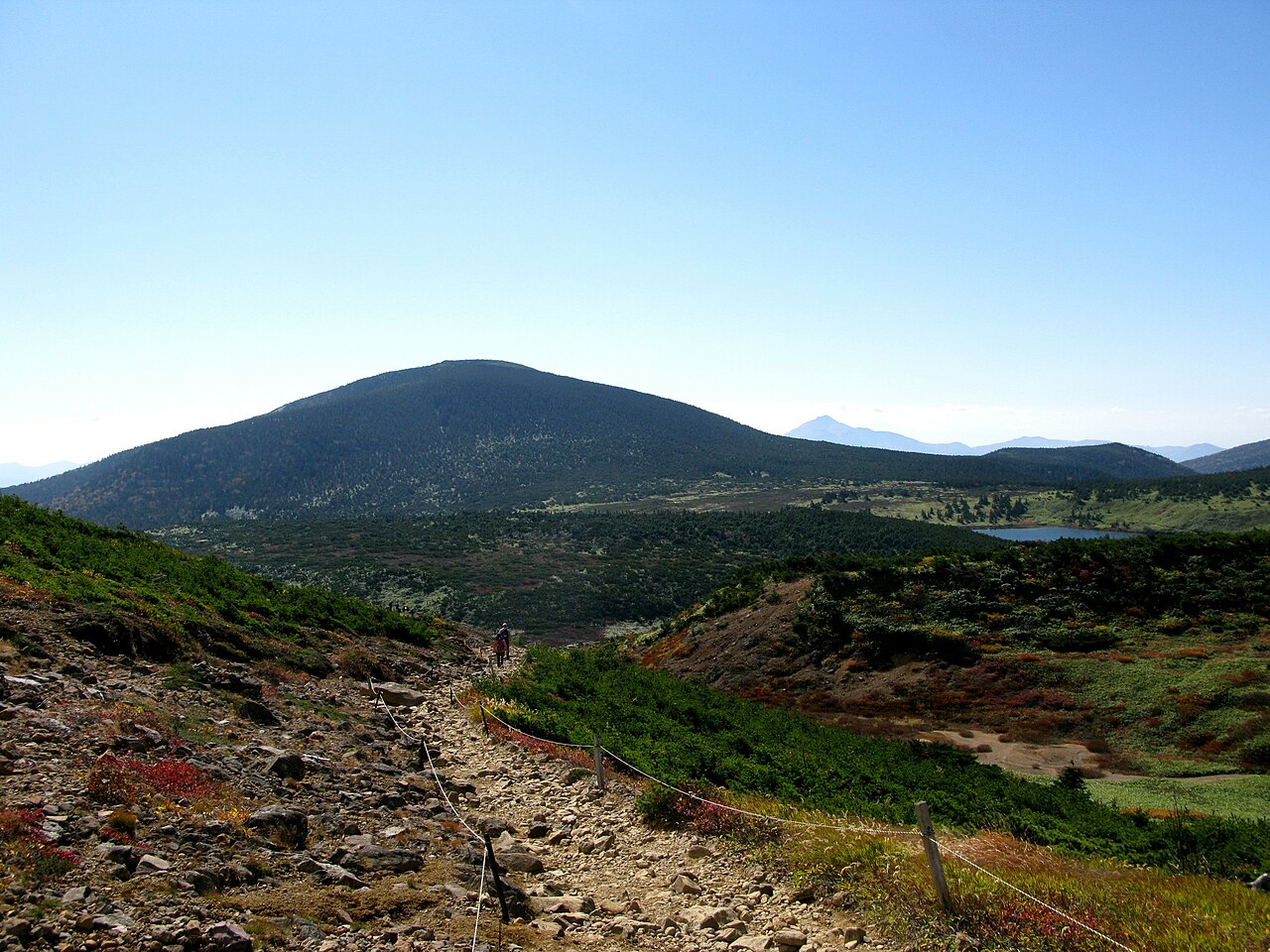
The surrounding landscape—flat agricultural land beneath the Adatara range, with mountain fog possible in autumn mornings—still suggests the original moor’s isolation. The site is genuinely modest: no theatrical staging, no haunted-attraction apparatus. A stone, a tree, a stream, a mountain behind. The atmosphere requires active imagination, which is precisely the condition that makes it work.
Visiting Approach
From Nihonmatsu Station, taxi or bus to the Kurozuka site (20–30 minutes). The site requires no more than 30 minutes to experience; the contemplative value lies in the contrast between its smallness and the legend’s enormity. Combine with the hilltop Nihonmatsu Castle ruins and the dramatic autumn lantern festival if visiting in October.
THE FORMER EXCLUSION ZONE: A LANDSCAPE OF ABSENCE
Context and Approach
This section addresses Fukushima’s most contemporary atmospheric location with particular care. The evacuation zone established after the March 2011 nuclear accident at the Fukushima Daiichi plant has been progressively reduced as radiation levels have declined to safe standards. As of 2025, most of the former zone is accessible, though some areas nearest the plant remain restricted.
Important: This is not a tourist attraction and should not be approached as one. The landscape of the former zone carries the weight of displacement—over 100,000 people who were ordered to leave within hours and could not return for years, many of whom lost elderly relatives, agricultural livelihoods, and community bonds that cannot be restored. Visiting requires a quality of respectful witnessing, not rubbernecking.
What Visitors Encounter
In the accessible former zone towns—particularly Naraha and Kawauchi—the process of repopulation is visible and ongoing. Rebuilt infrastructure, returning residents, functioning shops and schools exist alongside buildings that remain vacant or shuttered since 2011. The juxtaposition is not theatrical; it is the actual current state of communities in the process of recovering from unprecedented disruption.
The landscape itself—particularly in agricultural areas where fields have been remediated—has a distinctive character: meticulous, carefully managed, carrying an awareness of its own history that farmland rarely possesses. The mountains behind and the Pacific visible in the distance are unchanged.
Visiting Approach
Research current access conditions through the Fukushima Reconstruction Station website before visiting. If you visit, consider the purpose: not to witness desolation (the zone is being actively rebuilt), but to understand the scale of the disruption and the resilience of recovery. Stop at community centers; speak with residents if invited; purchase local produce (the food safety testing conducted in the region is among the most rigorous in Japan).
Do not enter any area marked as restricted. Do not treat inhabited areas as photographic subjects without engaging with residents.
OUCHI-JUKU: THE TRAVELERS WHO NEVER LEFT
Legend Background
The Aizu Nishi Kaido mountain pass on which Ouchi-juku served as a rest stop was genuinely dangerous in the Edo period—heavy snowfall, banditry, and exposure combined to claim travelers who miscalculated conditions or delayed departure. Local tradition preserves several accounts of travelers who died on the mountain passes above the village and whose spirits are said to linger in the surrounding forest, unable to continue their interrupted journeys.
The Atmospheric Reality
The legend’s atmospheric value requires winter conditions to fully materialize. In deep January or February snow, when the thatched roofs are buried and the surrounding forest is completely white and silent, the isolation that made the original route dangerous becomes briefly tangible. The sounds of the village—doors, fire, distant conversation—end abruptly at the village boundary, replaced by the heavy silence of snow-loaded forest.
The shrine at the village’s southern end, where travelers traditionally made offerings before ascending the pass, is the most charged location. Early morning, before the shops open and the light has fully come, the village carries its accumulated centuries of transient human presence—people who stopped here, rested, and moved on, or didn’t.
Visiting Approach
Winter visits (January–February) provide the most atmospheric conditions. Arrive before 8am, when the village is quiet and the overnight snow is fresh. Walk the main street and the path to the hilltop viewpoint before commercial activity begins. The shrine at the south end deserves 10 minutes of quiet attention.
Note for Visitors: Fukushima’s atmospheric locations reflect different kinds of haunting—battlefield tragedy, legendary horror, contemporary displacement, and the simple weight of time passing in isolated places. Engage with each on its own terms, and carry the recognition that what makes these places powerful is entirely real, even when the specific claims attached to them remain uncertain.