Fukushima’s Hidden Gems: A Traveller’s Guide to the Overlooked Prefecture
Fukushima’s famous sights—Tsurugajo Castle, Ouchi-juku, the Goshiki-numa lakes—attract enough visitors that their magic is well-established. But the prefecture holds a second layer of treasures that most travel itineraries never reach: a mountain village where Kabuki theatre has been passed between farming families for three centuries, a storehouse district that rivals any in Japan, a cherry tree so singular that it has its own name, and a highland trail above the clouds where volcanic activity shaped the ground beneath your feet.
1. Hinoemata Village: Living Kabuki in the Mountain Depths
At the southern end of Fukushima’s most remote mountain valley, surrounded by primeval beech forest that shields it from the modern world, Hinoemata village (population: 500) has performed Kabuki theatre every August for approximately 300 years. This is not cultural preservation theatre—it is a living community tradition in which local villagers, including children, farmers, and shopkeepers, study roles and perform on an outdoor stage that has occupied the same riverside location since the Edo period.
Why it’s overlooked: Hinoemata sits at the end of a long mountain road with no rail connection and limited bus service. The August performance (Hina Kabuki) requires advance awareness; it doesn’t advertise internationally.
What makes it exceptional: Unlike professional Kabuki, where hereditary actors play the same roles for decades, Hinoemata’s performances involve community members across generations, creating a rawness and genuine emotional investment that polished performances cannot replicate. Watching a farmer’s daughter perform a warrior princess role on the same wooden stage her grandmother performed on carries a weight that professional theatre rarely achieves.
Access: From Aizuwakamatsu, take the Aizu Tetsudo line to Aizukogen-Ozeguchi Station (60 minutes), then taxi or limited bus to Hinoemata (40 minutes). Rental car from Aizuwakamatsu is far more practical. The road through the Tadami River valley is itself spectacular.
Best time: The Hina Kabuki festival in mid-August is the main event; but the village, beech forests, and access to Oze National Park are rewarding any time from May through October. The Ozegahara boardwalk (45 minutes walk from the Yamanohana trailhead near the village) reaches Japan’s most famous highland marsh.
2. Kitakata’s Kura District: 3,000 Storehouses and Counting
Kitakata is famous internationally for its ramen—and that fame, deserved as it is, has completely overshadowed the fact that this small city possesses the densest concentration of traditional kura (storehouses) in Japan. Over 3,000 kura survive within the city limits, far surpassing better-known storehouse towns like Kurashiki or Tonosho.
Why it’s overlooked: The ramen narrative dominates. Most visitors arrive by train for the ramen, eat, and leave without exploring the streets. The kura are not clustered in a single district but dispersed throughout the city—requiring walking to discover.
What makes it exceptional: Kitakata’s kura were built primarily during the Meiji era (1868–1912), when the city’s sake, miso, and soy sauce industries generated enough wealth for merchants to build permanent storage. The regional style uses distinctive latticed plasterwork and heavy black-tile roofing. Walking the side streets between ramen shops, you’ll stumble on ancient sake breweries, miso producers, and family residences whose storehouses dwarf their main houses. The contrast between the humble residential architecture and the imposing kura creates a uniquely Japanese visual syntax.
The Shibata Kura complex on Otemachi-dori is the most accessible cluster for visitors, with several buildings open for exploration. The 1.5-km Kura-no-machi Walking Course passes over 50 significant storehouses and is mapped at the tourist information office near the station.
Access: Kitakata is 15 minutes from Aizuwakamatsu by JR Ban’etsu West Line. The main storehouse walking area is 10 minutes on foot from the station.
3. Miharu Takizakura: Japan’s Most Famous Cherry Tree
Every April, a 1,000-year-old weeping cherry tree in the small town of Miharu draws pilgrims from across Japan. The Miharu Takizakura is not a stand of trees or a park—it is a single specimen, classified as a National Natural Treasure, with a canopy spanning 25 metres in every direction. When in full bloom, its cascading pink-white branches resemble a waterfall of blossoms (taki means waterfall, sakura means cherry).
Why it’s overlooked: Miharu is genuinely off the tourist circuit. There is no major city nearby, the station is small, and English signage is minimal. International visitors unfamiliar with Japanese cherry blossom culture simply don’t know this tree exists.
What makes it exceptional: Unlike the row-planting of cherry trees in parks and along riverbanks—beautiful but repetitive—this single ancient tree represents centuries of individual survival. The slight irregularity in its branches, the massive gnarled trunk that has absorbed a millennium of seasons, the evident antiquity—these qualities give it a presence that Yoshino and Ueno cannot offer. Local volunteers and the town of Miharu have tended it for generations; visiting feels like paying respects to something irreplaceable.
Access: From Koriyama Station, take the JR Suigun Line to Miharu Station (25 minutes). The tree is a 30-minute walk or 5-minute taxi from the station. Peak bloom typically occurs in mid-April, 3–5 days after Fukushima City’s valley cherries. Check the Miharu Town website or X/Twitter for real-time bloom status.
Timing tip: The official viewing area fills completely on weekend afternoons during peak bloom. Arrive before 8am for the unhurried experience—morning light catches the blossoms from below, creating the most dramatic photographs.
4. Mount Adatara: The Accessible Alpine Dreamscape
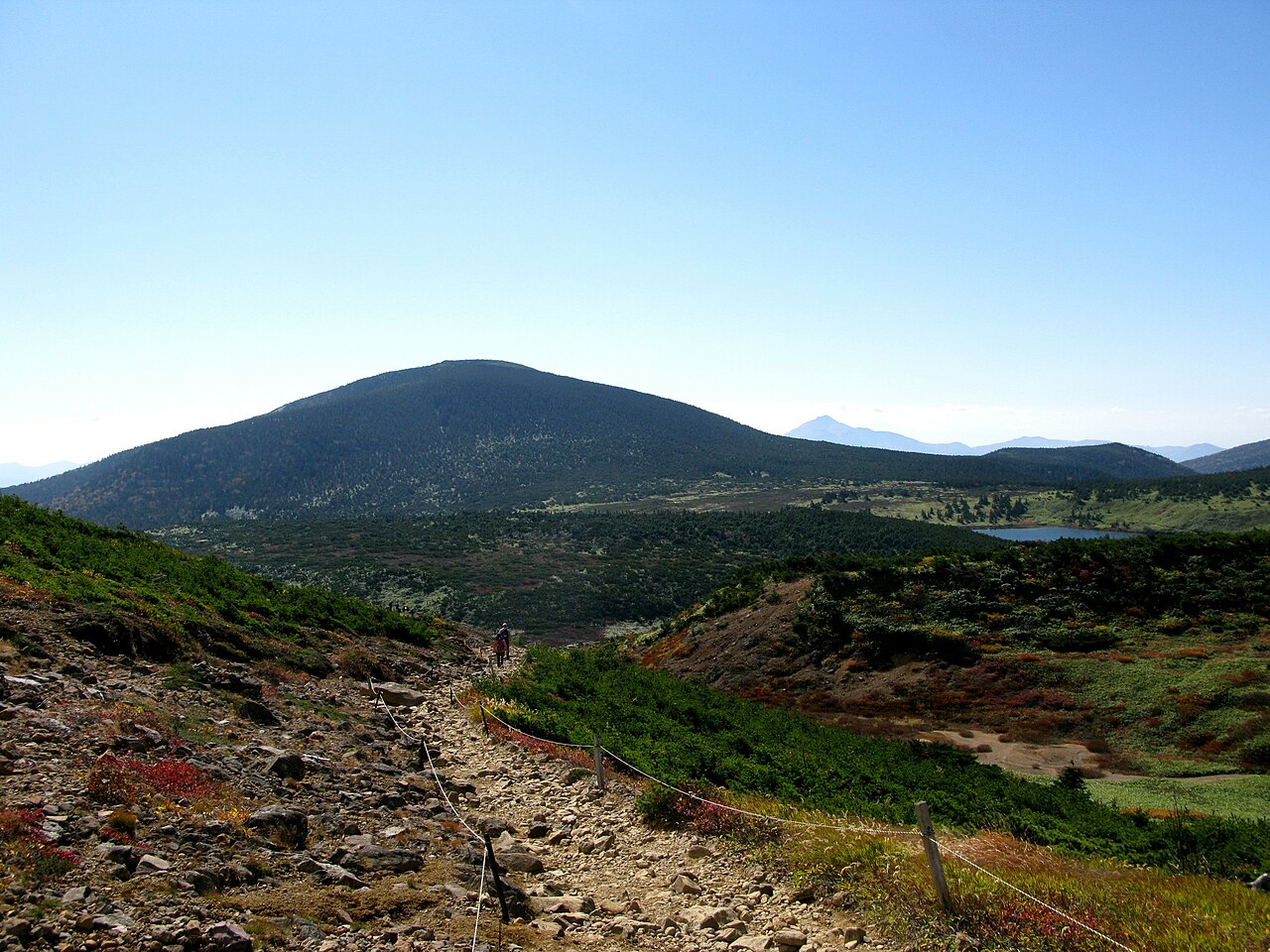
Rising directly behind Nihonmatsu City, Mount Adatara (1,700m) offers one of Japan’s best ratios of effort to reward. A gondola lifts visitors to 1,350m, leaving only a 40-minute hike to the volcanic summit. Yet Adatara’s rewards rival far more demanding mountains.
Why it’s overlooked: Adatara lacks the brand recognition of Fuji or Dewa Sanzan. Its accessibility is sometimes misread as insignificance. International visitors rarely venture inland from Fukushima City.
What makes it exceptional: The summit ridge walk traverses volcanic terrain that feels lunar—coloured rocks, steaming vents, crater lakes of impossible turquoise. The panoramic view encompasses Bandai to the north, the Ou Mountains to the west, and on clear days, the Zao range of Yamagata. The poet Takamura Kotaro wrote his most famous poem cycle, “Chiekosho” (Chieko’s Sky), about Adatara—his wife Chieko believed the sky above this mountain was Japan’s only truly clear sky. The poem is read at every Japanese high school; the mountain it describes is largely unknown to foreigners.
Access: Rental car from Nihonmatsu Station (25 minutes). The gondola operates spring through autumn; check the resort website for seasonal hours. Summer wildflowers (July–August) and autumn colours (early October) are the best seasons.
5. The Fukushima Fruit Line: Farm Culture You Eat
Route 72 and its surrounding network of country roads in central Fukushima constitute what locals call the “Fruit Line”—40 kilometres of orchard country between Fukushima City and Date City where volcanic soil and mountain temperature variation produce Japan’s most celebrated stone fruits. The Fruit Line is not a formal tourist attraction. It is simply where food comes from.
Why it’s overlooked: The Fruit Line requires a car and offers nothing conventionally “touristic.” There are no manicured visitor facilities, no English signage, and no organized tours. It rewards agricultural curiosity and a willingness to stop.
What makes it exceptional: In cherry season (mid-June), the roadside stands operate on trust—small tables with weighing scales, price lists, and cash boxes, often unmanned. You select cherries, weigh them, calculate the price, leave the cash. In peach season (July–August), farm families sit under sun shelters next to crates of just-picked fruit, often offering slices to taste before you purchase. These are the peaches that arrive in Tokyo gift shops at ¥2,000 apiece; here they cost ¥300 and taste of everything the gift-wrapped version has lost.
Pick-your-own experiences operate at many farms along the route; look for signs reading 桑摘み体験 (cherry picking) or 桃狩り (peach picking). Prices range from ¥1,000–2,000 for 30 minutes of unlimited eating.
Access: Rent a car in Fukushima City and head north on Route 4, then turn onto Route 72 at Date City. The best farms are signposted on the rural roads between the two cities.
Fukushima rewards those who look past the obvious. The prefecture’s hidden layer—a Kabuki-performing mountain village, a city of ancient storehouses, a single cherry tree that carries a thousand years of care—represents Japan’s cultural depth at its most unglamorous and authentic.