Spiritual Power Spots Guide to Fukushima Prefecture
Fukushima Prefecture’s spiritual landscape is shaped by samurai devotion, volcanic earth, healing waters, and the weight of collective sacrifice. The prefecture’s power spots are not celebrated internationally with the frequency of Kyoto’s shrines or Nikko’s temples, but their spiritual energy is no less profound—in many cases, it is more concentrated for having been tested by tragedy and maintained by genuine community faith rather than tourism apparatus.
1. Aizu Shrine (会津神社) & Tsurugajo Sacred Ground
The grounds of Tsurugajo Castle hold more than reconstructed architecture—they carry the residual energy of one of Japanese history’s most extreme collective demonstrations of loyalty. When the Meiji imperial forces besieged the castle in 1868, the defenders—including women, children, and elderly residents of the Aizu domain—chose to fight or die rather than surrender to what they understood as an illegitimate authority. The castle fell, but the spirit of Aizu, defined by Han precept as loyalty, obligation, and honoring commitments above personal survival, became embedded in the ground itself.
The Aizu Shrine within the castle grounds venerates this spirit directly. It was established to honor the Aizu domain’s loyal sacrifice—particularly those who died during the siege. Visiting the shrine as a power spot means engaging with the specific spiritual energy of collective conviction tested beyond endurance.
Spiritual Energy: Loyalty, devotion to principle, courage in the face of overwhelm, the sacredness of keeping one’s word.
Visiting Etiquette: Approach with awareness of the historical weight. The castle moat walk (free) provides meditative preparation before entering the shrine precinct. Early morning (7–8am) offers the most concentrated atmosphere; the light through the cherry trees along the moat path in spring creates an exceptional contemplative environment.
Best Time: April, when 1,000 cherry trees bloom around the castle walls, and the combination of spring renewal and historical weight creates powerful contrast. January–February, when snow simplifies the landscape to essential forms.
2. Iimori Hill & the Byakkotai: Sacred Ground of Collective Sacrifice
Iimori Hill, where nineteen teenage samurai boys made their final decision in September 1868, holds spiritual weight that extends far beyond any formal religious classification. The Byakkotai (White Tiger Brigade) were 16–17 years old, members of Aizu’s junior warrior reserve who retreated to this hilltop during the battle and, seeing what they believed was their castle in flames, chose ritual death over the surrender they had been raised to regard as dishonor.
One boy survived and told their story. The other eighteen graves remain on the hillside, simple stone markers looking toward the castle they died protecting. Flowers and offerings appear at the graves constantly—brought not by official maintenance but by ordinary Japanese people who continue to feel the pull of this story.
The Spiritual Dimension: The Byakkotai site operates as an informal power spot within Japanese popular spiritual practice—associated with the energy of devoted intention, the sanctity of youthful conviction, and the profound weight of a decision made completely. Whatever one’s personal politics regarding their cause, the sincerity of their action generates genuine spiritual presence.
The Sazaedo Pagoda nearby, a remarkable 3-storey wooden pagoda with a double spiral staircase that allows simultaneous ascent and descent without passing other visitors, carries its own energy—a physical manifestation of the Buddhist concept of non-duality built in 1796 by a Zen priest. The interior hosts 33 Kannon images along the spiraling route; climbing it is itself a small pilgrimage.
Visiting Etiquette: Approach the graves with the silence you would bring to any war memorial. Observe personal items visitors leave; touch nothing. The hilltop view toward the castle is the essential experience—stand and look for several minutes, considering what the boys saw and decided.
Best Time: Late afternoon, when low light and decreased crowds allow unhurried engagement. Dawn visits for serious seekers.
3. Oyakuen: The Medicinal Garden of the Aizu Lords
Oyakuen (御薬園, the Medical Garden) is Aizuwakamatsu’s most quietly powerful place. Established in the 17th century as a medicinal herb garden for the Aizu domain lord, it has cultivated plants associated with healing for over 350 years. The central pavilion, surrounded by a contemplative strolling garden, once served as the domain lord’s retreat and recovery space.
The Spiritual Character: Oyakuen’s energy is restorative rather than dynamic—associated with healing, patience, natural cycles, and the long view. The garden embodies the concept of a place maintained across generations specifically for recovery: from illness, from stress, from the world’s demands. Walking the paths among medicinal herbs and over traditional bridges while the central pond reflects sky operates as a moving meditation.
The 2011 earthquake left structural damage to some buildings but the garden survived and was lovingly restored—an act that reinforced its character as a space maintained across crises.
Visiting Etiquette: Walk slowly. The medicinal plants are labelled (mostly Japanese, some bilingual); read them as encounters with centuries of accumulated botanical knowledge. The central pond pavilion is a contemplative rest point; pause there.
Best Time: June for irises and early summer greenery; October for autumn colors over the traditional architecture. The garden’s quietest and most powerful hours are before 9am.
4. Ouchi-juku: Mountain Pass Deity Traditions
Ouchi-juku was not merely a post town for traveler rest—it was the human habitation at the foot of a mountain pass known for dangerous conditions, where the boundary between safe and unsafe travel was literally present in the terrain. The small shrine at the southern end of the village honors the mountain deity (yama-no-kami) who governs safe passage and agricultural abundance.
Traditional communities in the Japanese mountains developed particularly intimate relationships with local deities, understanding them as active presences requiring ongoing acknowledgment rather than distant figures approached at annual festivals. In Ouchi-juku, this relationship has been continuous—the village has never been entirely abandoned or “preserved” as a museum, meaning the spiritual practices have continued alongside the economic and cultural functions.
Visiting Etiquette: The shrine is small and easily overlooked amid the post-town attractions. Take time to find it at the village’s south end. Make a small offering (coins in the box), bow, and spend a moment in acknowledgment.
Best Time: Early morning before commercial activity begins, when the village’s original character is most accessible.
5. Mount Adatara: Volcanic Sacred Ground and the Poet’s Sky
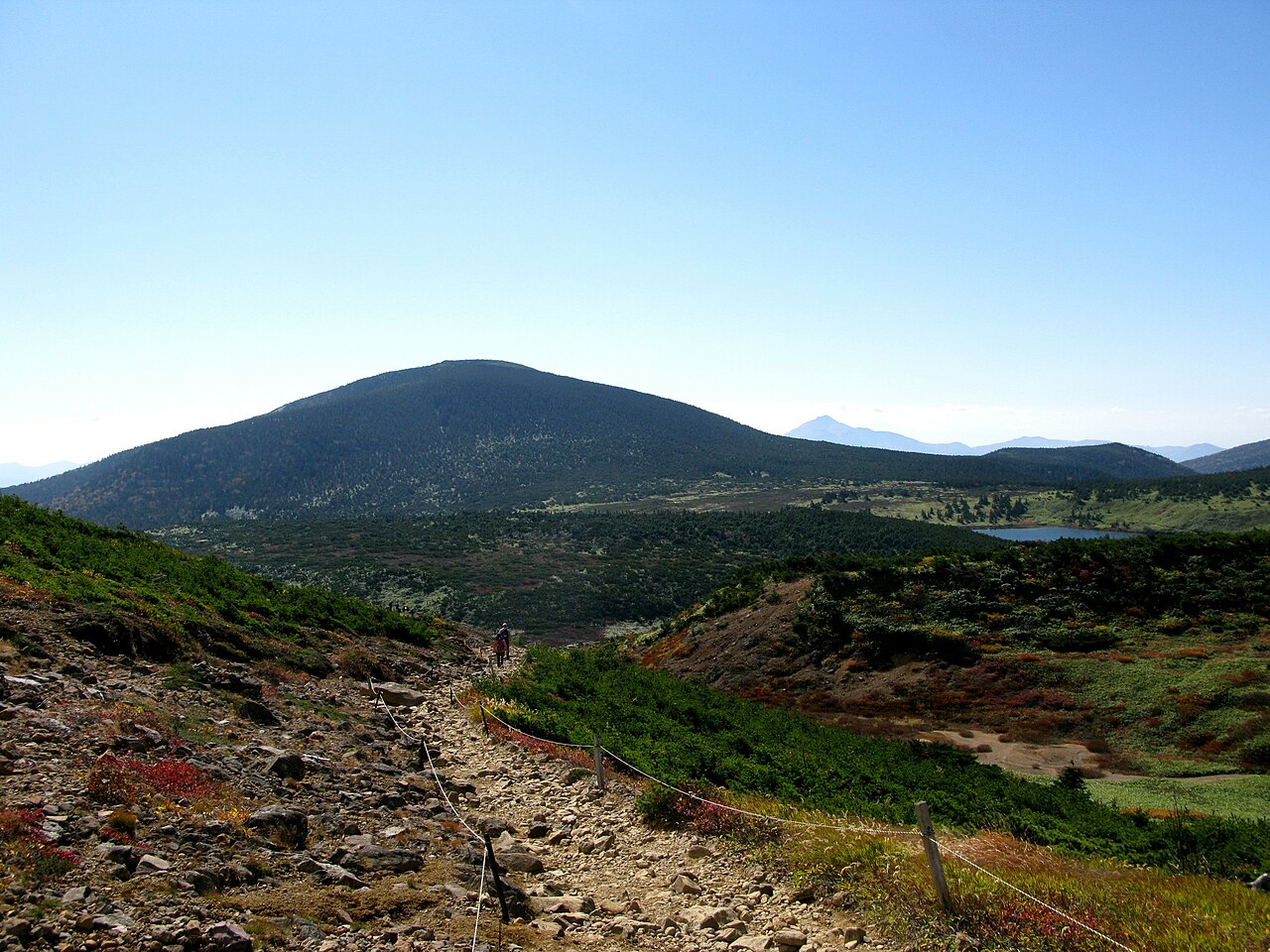
Mount Adatara has been venerated as a sacred peak in the Tohoku mountain system for centuries, but it entered modern Japanese cultural consciousness through the poet Takamura Kotaro, whose grief-poem cycle “Chiekosho” describes Adatara’s sky as the only truly clear sky left in Japan.
The mountain combines volcanic spiritual energy—sulfurous vents, crater lakes, primordial rock—with the cultural power of Japan’s most studied modern poem sequence. The summit area’s Mao-no-hitomi crater lake (Devil’s Eye) is particularly associated with liminal spiritual experience: its color shifts from green to turquoise depending on atmospheric conditions, and it sits in a bowl of volcanic rock that excludes ordinary landscape entirely.
Spiritual Energy: Volcanic primordial force, creative inspiration, the relationship between grief and transcendence, clarity that comes through natural extremity.
Visiting Etiquette: The gondola approach (spring–autumn) allows visitors to engage the mountain’s volcanic character without technical climbing skill. The 40-minute hike from the gondola summit station to the peak crosses the volcanic zone. Treat the sulfurous terrain with respect—it is active, not decorative. Do not approach steaming vents.
Best Time: Early October for autumn colors against the volcanic landscape; early July for alpine wildflowers. Clear days only—the spiritual experience of Adatara depends on the famous clarity of its sky.
Practical Note: Fukushima’s power spots are distributed across the prefecture and cannot be visited in a single day. The Aizu cluster (Aizu Shrine, Iimori Hill, Oyakuen, Ouchi-juku) forms a natural 2-day circuit. Mount Adatara is best visited from Nihonmatsu as a half-day extension. Allow time to sit at each location rather than moving through them; these are places that reveal themselves to those who arrive with patience.