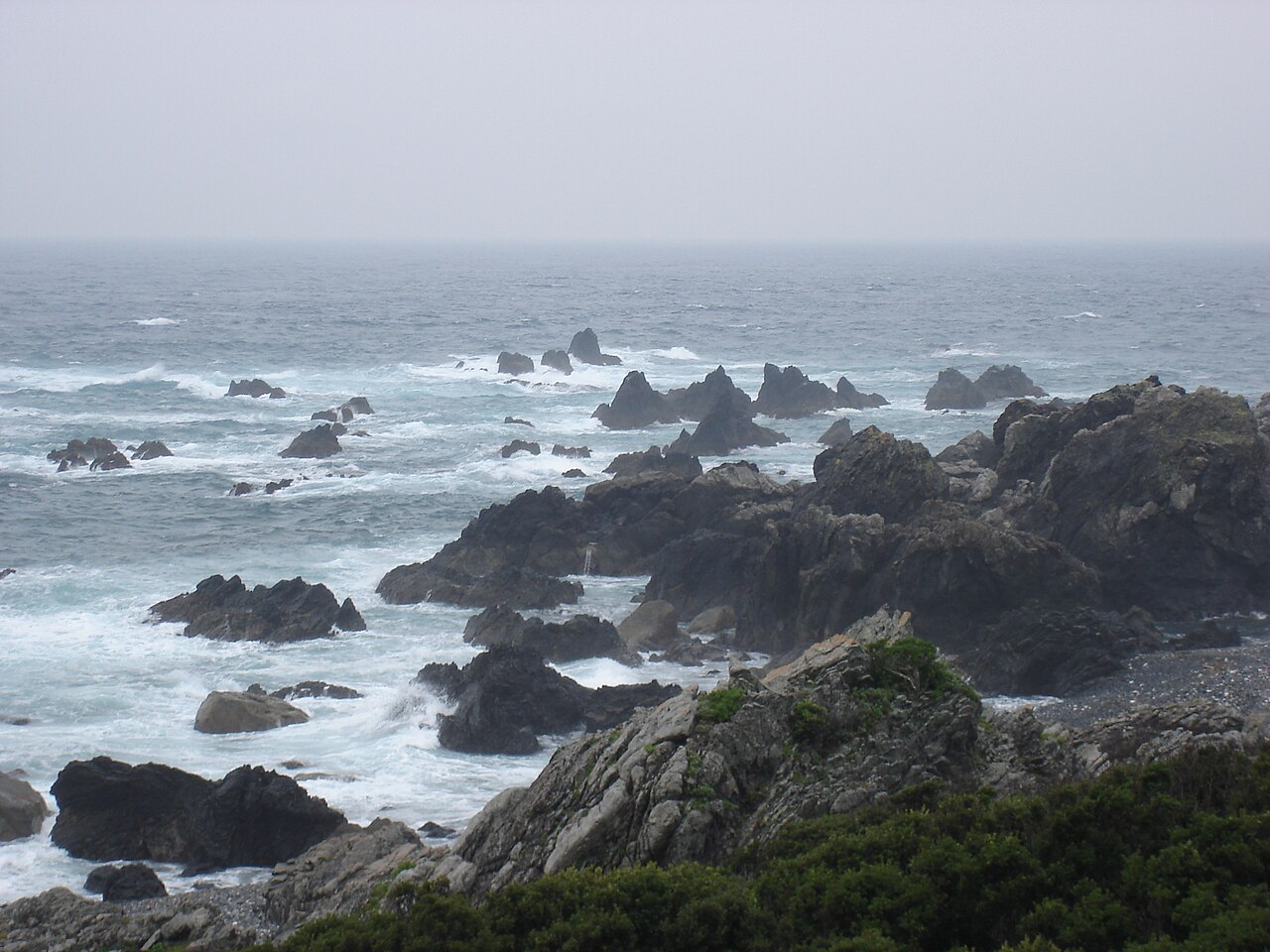
Kochi Prefecture occupies the southern quarter of Shikoku, facing the Pacific Ocean across a rugged coastline of dramatic capes, river mouths, and fishing harbours. It is the largest and least densely populated of the four Shikoku prefectures, which means that beyond the lively provincial capital, much of the landscape is genuinely wild. The sights here are spread across long distances, and a rental car unlocks the prefecture in a way that no public transport itinerary can fully replicate. That said, Kochi City itself repays two to three days of unhurried exploration, and the train network connects the city to the main coastal landmarks with reasonable frequency.
Kochi Castle
Kochi Castle stands as the only castle in Japan where all of the major original Edo-period structures have survived intact — the main keep, the connecting corridors, the honmaru palace buildings, the watchtowers, and the main gate (Ote-mon) all remain from their original construction periods. Most of Japan’s surviving castles have lost at least some ancillary structures to fire, war, or demolition; Kochi’s complete survival is exceptional.
History and Architecture
Construction began in 1601 under Yamauchi Kazutoyo, a general who received the Tosa domain as a reward after the Battle of Sekigahara. The main keep burned in 1727 and was rebuilt between 1748 and 1753 to the same design, which is why the castle appears Edo-period throughout despite the later reconstruction. The rebuild is itself over 270 years old. The main gate (Ote-mon) is a National Treasure of Japan.
The castle sits on a modest hilltop above the city centre, approached through two successive stone-walled enclosures. The interior displays period weaponry, historical documents of the Yamauchi clan, and information panels about the castle’s role in the late Edo period when Tosa samurai — including the revolutionary figure Sakamoto Ryoma — became central to Japan’s transformation.
Entry ¥420. The castle grounds look directly down onto the Otesuji Boulevard where the Sunday Market spreads below.
Access: Tosa Dentetsu streetcar from Kochi Station to Kochi-jo-mae stop, 10 minutes, ¥200.
Kochi Sunday Market
The Nichiyo Ichi (Sunday Market) has run every Sunday along Otesuji Boulevard since the early 18th century, making it one of the oldest regular markets in Japan. Over 400 stalls line approximately one kilometre of the main boulevard from around 5 am until early afternoon. The market is dominated by vegetables and plants — local farmers selling direct from their plots — but includes handmade tools, crafts, second-hand goods, household items, and a rotating assortment of street food.
The market is most atmospheric and best-stocked before 10 am. The fishermen’s stalls near the castle end of the boulevard, selling fresh Tosa seafood and dried bonito products, are a particular draw. Entry is free. Budget ¥500 to ¥1,500 for food and small purchases.
The market coexists naturally with the castle above it — a Sunday morning visit can combine both without requiring transport.
Katsurahama Beach and the Ryoma Legacy
Katsurahama is a headland beach south of Kochi City where pine-covered cliffs frame a curved bay of dark sand. The Pacific swell here is powerful and currents are dangerous; swimming is prohibited, which means the beach functions as a scenic viewpoint rather than a bathing destination. The setting is genuinely dramatic — particularly in winter when the Pacific is rough and the sky turns green-grey.
Sakamoto Ryoma Memorial Museum
The beach is most famous as the site of the large bronze statue of Sakamoto Ryoma, the Tosa samurai who became one of the key architects of the Meiji Restoration. Born in 1836 in Kochi City, Ryoma left his domain unlawfully — a capital offence for a samurai — to work outside the established system toward the unification of Japan under a new government. He was assassinated at 31, less than a year before the Restoration he helped engineer. The Ryoma Kinenkan (Sakamoto Ryoma Memorial Museum) stands just above the beach and tells his story in considerable detail, with excellent English-language panels. Entry ¥700.
Ryugado Cave
40 kilometres east of Kochi City (45 minutes by car), Ryugado is a limestone stalactite cave extending several hundred metres into a hillside. Entry ¥1,000. The cave’s formations developed over hundreds of thousands of years and include a naturalised Jomon-period human skeleton found in situ. A combined half-day trip to Katsurahama and Ryugado works well from Kochi.
Access to Katsurahama: Tosa Dentetsu streetcar to Harimayabashi, then MY遊バス (tourist hop-on bus) to Katsurahama. Total approximately 40 minutes from Kochi Station. MY遊バス day pass ¥1,000.
Hirome Market
Hirome Ichiba is an indoor food market and gathering hall a short walk from Kochi Castle. Dozens of independent food stalls share a large communal space with long tables and benches, and it functions as a cross between a food court, an izakaya, and a neighbourhood gathering place. The market is open from lunch through late evening, seven days a week.
The energy is distinctive and very Kochi: locals and visitors eat side by side without ceremony. Cold Kirin beer on tap. Katsuo tataki grilling over rice straw in open kitchen setups. Whale meat in season. Sea cucumber (namako) raw or simmered. Tosa gyoza. Local sake available by the bottle.
The market is most lively between 6 and 9 pm when the after-work crowd arrives. Weekend afternoons are also busy. Budget ¥1,500 to ¥2,500 for a full meal with drinks. The market is free to enter and requires no reservation; simply find an open seat and order from any stall.
Access: 5-minute walk west of Kochi Castle.
Cape Ashizuri
Ashizuri-misaki is Japan’s southernmost point on Shikoku, a 90-metre cliff headland jutting dramatically into the Pacific at the end of Hata Peninsula in southwestern Kochi. The cape is geologically imposing and completely isolated from the main tourist circuits — reaching it from Kochi City takes approximately 2 hours by limited express train plus taxi.
The Cape’s Landmarks
The lighthouse at Ashizuri-misaki was established in 1914 and marks the turning point for vessels moving between the Pacific and the Kii Channel. Walking paths follow the cliff edge through subtropical vegetation. The views along the cliff face from the cape’s promontory are among the most dramatic on Shikoku.
Kongofukuji Temple, adjacent to the lighthouse, is Temple 38 of the Shikoku 88-Temple Pilgrimage — a significant waypoint for the henro pilgrims who walk the full circuit. The temple’s main hall and five-story pagoda stand in a garden overlooking the Pacific.
The cape is ideally combined with a visit to the Shimanto River on a two-day southwestern Kochi circuit, using Nakamura as a base.
Access: JR limited express Ashizuri from Kochi Station to Nakamura, approximately 2 hours, ¥3,150. Taxi from Nakamura to the cape, approximately 50 minutes (¥6,000-8,000 one way). Rental car strongly recommended for this region.