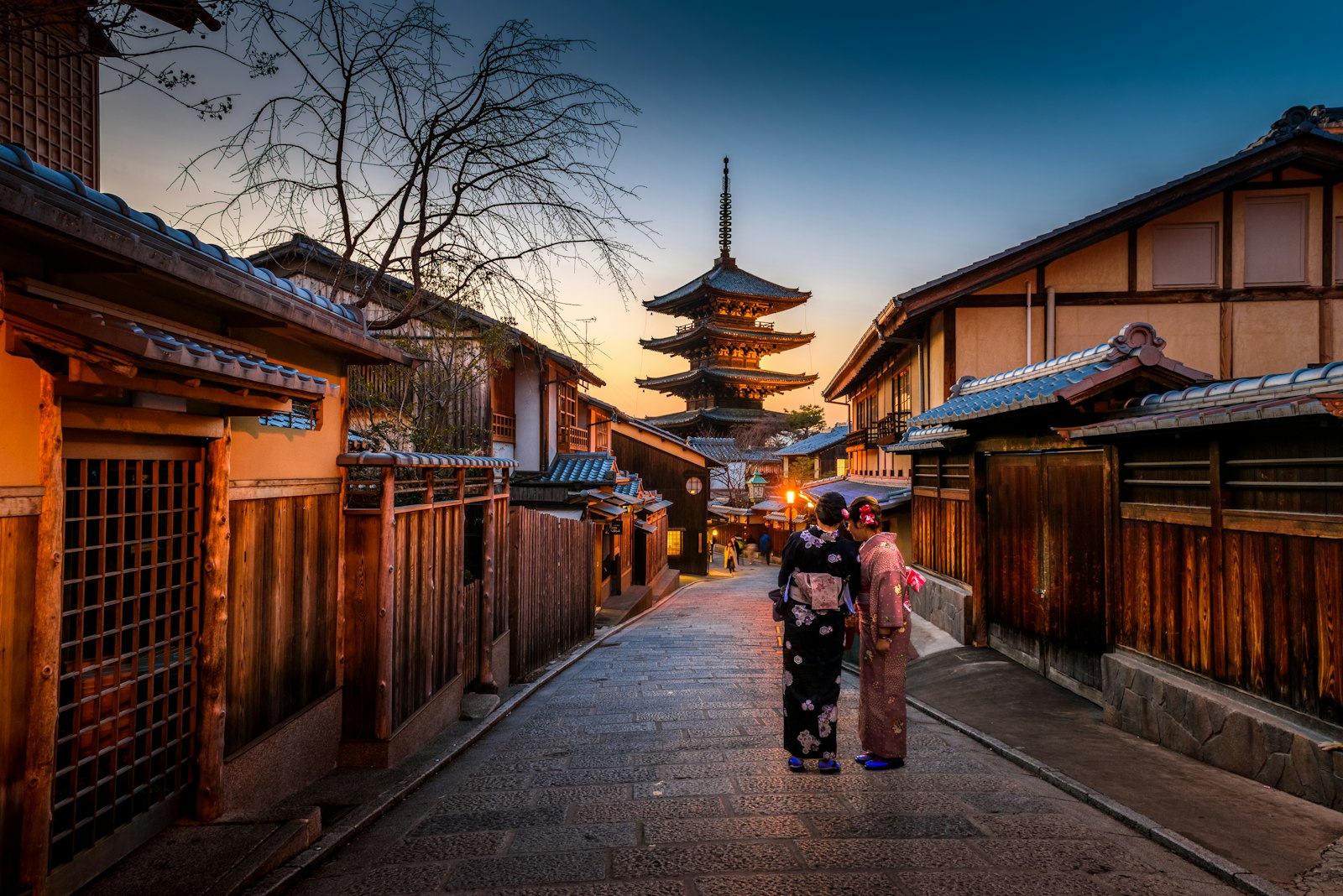
Kyoto’s nature is inseparable from its culture — the city’s temples and shrines were built to frame specific views of mountains, rivers, and seasonal trees. Cherry blossoms at the Philosopher’s Path, autumn maples at Jojakko-ji, moss gardens at Saihoji, cedar forest at Fushimi Inari — each experience is both natural and profoundly designed. This guide covers Kyoto’s finest nature experiences, with the practical timing that makes the difference between the experience and a photograph of the experience.
🎋 Arashiyama Bamboo Grove — The Sound That Cannot Be Photographed
Access: Arashiyama Station (Randen tram from Shijo-Omiya or JR Sagano Line from Kyoto Station) Hours: Always open | Admission: Free
The bamboo grove path runs 200m between Tenryuji’s north gate and Okochi Sanso villa — a corridor of giant moso bamboo (reaching 20m), the stems so dense that daylight filters green-gold. The photographs know this place, but the sound does not travel through them: on a breezy morning, the upper stalks knock against each other with a hollow, resonant percussion that is entirely unlike the sound of leaves in wind — more like distant wooden wind chimes at scale. This is what the grove actually is; the images are its shadow.
Timing: The path is passable from early morning before the crowds arrive — after 9:30am it becomes a procession. Visit before 7:00am for the full acoustic experience in near-solitude. The grove is equally beautiful in rain (the bamboo deepens to blue-grey) and in early morning mist (the upper canopy disappears into white).
Beyond the main path: The bamboo continues uphill behind Jojakko-ji temple and into the mountain forest — a 30-minute walk past small farm plots and persimmon orchards reveals a second, quieter bamboo section with no tourists. Follow the lane behind Jojakko-ji north.
🌸 Philosopher’s Path — Cherry Blossoms & Canal Side Walking
Access: Ginkakuji-mae bus stop or Keage Station (Tozai Line) + 10 min walk Distance: 2km | Duration: 40–60 min walking (plus stops)
The Philosopher’s Path (Tetsugaku no Michi) follows a narrow canal between Ginkakuji and Nanzenji, lined on both sides with single-flowered cherry trees (somei yoshino) whose branches interlock above the water. The canal dates to the Meiji period — constructed to carry water from Lake Biwa — and the footpath is named for philosopher Nishida Kitaro, who walked here daily while teaching at Kyoto University.
Cherry blossom timing (late March–early April): The peak window is narrow — 5–7 days of full bloom, typically the last week of March to the first week of April. At full bloom, petals fall continuously into the canal water, creating a floating pink carpet. The walk is best before 8:00am during cherry season; from 10:00 onward it becomes very crowded. An app like Hanami Japan gives daily bloom status updates.
Autumn colours (mid–late November): The canal path turns orange-red with reflected maple light; the café gardens along the route (especially Omen restaurant’s garden and the small tea stalls at the Nanzenji end) become intensely atmospheric. Less crowded than spring peak but still busy at weekends.
What to find along the path: Small galleries, coffee houses in converted townhouses, a tofu shop with samples at the door, and the Honen-in temple gate (5 min off the main path) — a steep thatched gate opening to a garden entirely of moss and raked sand. Honen-in charges no admission and receives a fraction of the foot traffic of Ginkakuji 10 minutes away.
🏔️ Kurama-Kibune Mountain Hike
Start: Kurama Station (Eizan Railway from Demachiyanagi, 30 min, ¥430) End: Kibune Station or walk back to Kurama Distance: 4km one-way | Duration: 2.5–3 hours | Difficulty: Moderate
This is one of the finest mountain hikes accessible from a major Japanese city — a trail rising from the sacred Kurama temple through a cedar and sugi forest to a mountain pass at 584m before descending into the Kibune valley below. The forest is ancient; many of the cedar trees are hundreds of years old with root systems that have lifted the stone path. The mountain itself is considered one of Kyoto’s three sacred peaks, associated with the deity Mao-son — a fusion of Venus, the Great Bear constellation, and the mountain’s indigenous spirit.
Route: Kurama Station → Kurama-dera Sanmon gate (¥300 entry to temple precinct) → Yuki Shrine (ancient hinoki trees) → Tobikiri stone → Ridge path → Oku-no-in inner sanctuary → Summit pass → Descent to Kibune → Kibune Shrine
At Kibune: The descent ends at Kibune Shrine — a chain of three connected shrines dedicated to the water deity, built beside a mountain stream. The approach path flanked by red lanterns and maple trees is one of Kyoto’s most cinematic spaces in autumn.
Kawadoko dining (June–September): The restaurants lining the Kibune River lower their wooden platforms (kawadoko) to within 50cm of the rushing water — dining directly above the mountain stream on platforms cooled by the water below. Somen noodles served cold in stream-cooled water, trout grilled beside you, sake chilled in the current. Reserve ahead at Hirobun (¥4,000+) or Kibune Club (¥6,000+ for kaiseki). This is one of Japan’s most unusual dining experiences and is genuinely inaccessible outside June–September.
⛩️ Fushimi Inari Summit Trail
Access: Inari Station (JR Nara Line, 5 min from Kyoto Station) Hours: Always open | Admission: Free Duration to summit and back: 2–3 hours
The 7,000 torii gates extend all the way to the summit of Mt. Inari (233m) — a fact that most visitors never discover because the lower sections are perpetually crowded and most turn back at the Yotsutsuji junction (40 min from base). Above the junction, the trail enters a different world: the crowds disappear almost entirely, the gates become more worn and mossy, the subsidiary shrines (yashiro) become smaller and more remote, and the forest silence deepens.
Summit experience: The true summit (Ichinomine) is a small, lantern-lit clearing with a rock altar — no café, no signage, no crowds. The path continues in a full loop back to the base (taking the east side descent through Higashiyama forest). The loop takes 2.5–3 hours total.
Best timing: Pre-dawn hike (4:30–5:00am start) arriving at the summit at sunrise — the city below lights up as the first light clears the eastern hills. Bring a torch for the approach.
🍁 Kyoto’s Greatest Seasonal Gardens
Spring
Daigo-ji (醍醐寺) — Fushimi One of Kyoto’s finest cherry blossom sites — 700 cherry trees on a hillside monastery complex, and the site of Toyotomi Hideyoshi’s legendary 1598 hanami (flower-viewing) party attended by 1,300 guests. The stone steps rising through the lower precinct under falling petals are extraordinary. JR Daigo Station + 10 min walk. ¥1,500 entry.
Maruyama Park (円山公園) — Higashiyama Kyoto’s most beloved cherry blossom gathering point — the central weeping cherry tree (shidare-zakura) is one of Japan’s most photographed trees. Unlike most cherry viewing sites, Maruyama is explicitly a picnic and celebration space — hanami parties (sake under the blossoms) are the norm from dusk onward. Free entry.
Jonangu Shrine (城南宮) — Fushimi The least-visited major spring garden in Kyoto — a sequence of five historically styled gardens (Heian, medieval, Momoyama, modern) with February plum blossoms and March weeping cherry. The shidarezakura weeping cherry arch over the garden stream is among Kyoto’s finest spring views and receives a fraction of Daigo-ji’s visitors. ¥700 entry.
Summer
Kibune Riverside — Northern Kyoto (see above; summer kawadoko dining)
Kamogawa Riverside — Central Kyoto The Kamogawa river path running the full length of the city (12km) is Kyoto’s open-air living room in summer — locals spread picnic mats on the riverbanks, couples sit facing the water at precise intervals (a well-known Kyoto custom — couples on the Kamogawa always sit equidistant from each other, enforced by social convention rather than any rule), and the pontocho restaurants extend wooden terraces (kawayuka) over the western bank June–September.
Autumn
Tofukuji (東福寺) — Fushimi (near) Japan’s single most concentrated autumn foliage display — a deep ravine crossed by a wooden bridge (Tsutenkyo) filled with 2,000 maple trees turning simultaneously. At full colour (typically the second week of November), the view from the bridge is a solid mass of red, orange, and gold. Arrive before 9:00am to avoid the extreme crowds. ¥600 entry.
Eikan-do (永観堂) — Higashiyama The most architecturally beautiful autumn temple — a complex of connected halls built on a hillside, with maple trees pressing against every window and the pond lit by lanterns on evening illumination nights (late October–late November, 17:30–21:00). One of the finest night illumination events in Kyoto. ¥600 (day); ¥1,000 (evening).
Jojakko-ji (常寂光寺) — Arashiyama The hidden autumn temple — a hillside pagoda surrounded by maples that only Arashiyama regulars discover, 10 minutes above the bamboo grove. The pagoda framed by autumn maples from the stone-stepped approach is one of Kyoto’s finest seasonal images. ¥500 entry.
Winter
Ryoanji snow garden: When Kyoto receives snow (typically 2–4 times annually, December–February), Ryoanji’s rock garden transforms — the white gravel and gray stones become indistinguishable from the snow, with only the tops of the 15 stones protruding. One of the rarest and most beautiful visual experiences in Kyoto.
Fushimi Inari at frost: The summit trail in early morning after frost — gates sheathed in white, cedar branches bowed under ice — is virtually undocumented by photographers because almost no one visits in winter cold. Dress warmly; crampons recommended after snowfall.
🌿 Kyoto’s Moss Garden: Saihoji (苔寺)
Access: Bus to Kokedera-Suzumushidera stop; 10 min walk Admission: ¥4,000 (reservation required by postcard or online — mandatory) Hours: Multiple sessions daily; session time ~1.5 hours
Saihoji (西芳寺), known as the Kokedera (Moss Temple), is the most controlled nature experience in Japan: entry requires advance application (minimum 1–2 weeks ahead), a mandatory sutra-copying session precedes the garden walk, and visitor numbers are strictly limited. The result — a garden of 120 species of moss covering every surface — is the most intense shade of green achievable in a natural space. The lower pond garden inspired nearly every subsequent Japanese garden design.
The sutra-copying (sit, copy characters with a brush, no prior experience required) functions as a calming preamble; visitors who skip in spirit arrive in the garden still carrying city energy. The 45-minute garden walk rewards stillness.
Kyoto Nature Seasonal Calendar
| Month | Highlight | Location | Notes |
|---|---|---|---|
| February | Plum blossoms | Kitano Tenmangu, Jonangu | Quietest season; 2,000 plum trees |
| Late March–April | Cherry blossoms | Maruyama, Philosopher’s Path, Daigo-ji | Peak 5–7 days; book accommodation months ahead |
| May | Fresh greenery (shinryoku) | Arashiyama, Fushimi Inari | The year’s most underrated season — brilliant green without crowds |
| June–September | Kawadoko riverside dining | Kibune, Pontocho | Rainy season in June; July–August hot but evening dining on the river is exceptional |
| Mid–late November | Autumn maples | Tofukuji, Eikan-do, Jojakko-ji | Peak 7–10 days; Tofukuji most dramatic |
| December–February | Snow gardens | Ryoanji, Fushimi Inari | Rare but spectacular; no crowds |