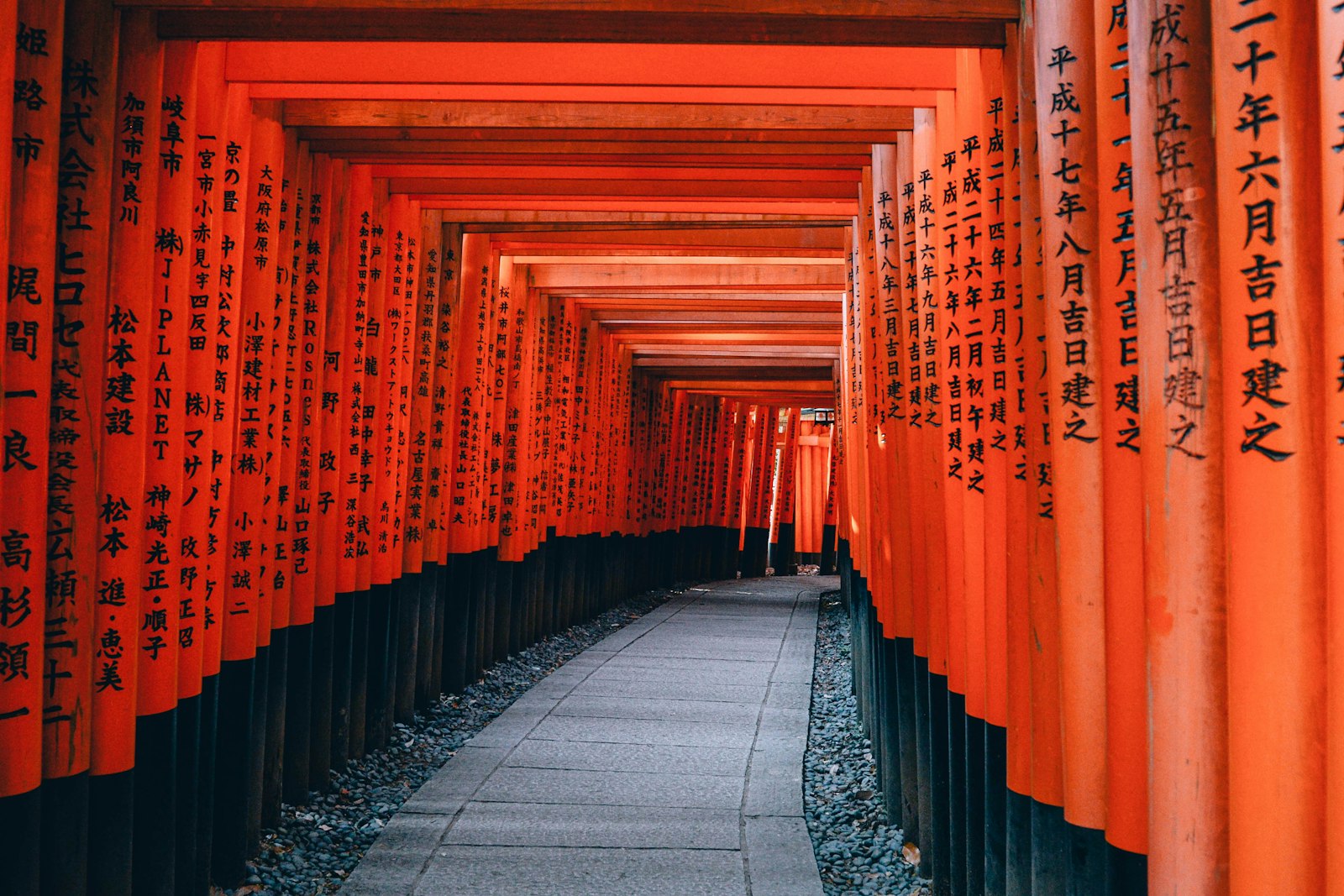
Kyoto contains 17 UNESCO World Heritage sites, over 1,600 Buddhist temples, and more than 400 Shinto shrines — the highest density of designated cultural properties in Japan. This guide selects the 25 essential experiences, organises them by district, and provides the specific timing and access information that separates a memorable visit from a crowded one.
⛩️ Fushimi Inari Taisha — The Thousand Torii Gates
District: Fushimi | Access: Inari Station (JR Nara Line, 5 min from Kyoto Station) — station exit opens directly to shrine gate Admission: Free | Open: 24 hours
The 5km network of 7,000+ vermillion torii gates climbing Mt. Inari is arguably Japan’s most photographed sight. Each gate was donated by a business or family seeking blessing from Inari — the deity of rice, sake, and commerce — and bears the donor’s name and date on its back panel. The bottom section (around the Senbon Torii dual-tunnel approach) is perpetually crowded from 9:00–17:00; the upper mountain trail above the Yotsutsuji junction (30–40 min from the base) is almost deserted.
The summit hike: The full circuit to the mountain peak (Ichinomine, 233m) takes 2–3 hours return and passes through 4 subsidiary shrine areas, each with its own character. Fox messenger statues holding jewels and keys appear throughout — Inari’s messengers in Shinto tradition.
Best timing: Gates are photogenic in all light, but the lower tunnels are empty 5:00–6:30am and after 8:00pm (gates are lit by lanterns at night). The trail above Yotsutsuji is quiet any morning before 9:00.
Insider notes:
- The back of each gate bears the donor’s name and date — reading these is a form of social history
- The Omokaru stone in the inner precinct: lift the stone lantern top and make a wish — if it feels lighter than expected, the wish will be granted; heavier, not
- Numerous small teahouses on the mountain trail sell matcha and suzume-yaki (grilled sparrows on skewers — a centuries-old Inari specialty); try it once
🏯 Nijo Castle — The Shogun’s Kyoto Palace
District: Central | Access: Nijojo-mae Station (Tozai Line) — 1 min walk Admission: ¥1,300 | Hours: 8:45–17:00; closed Tuesdays (Dec–Feb)
The Ninomaru Palace was the Kyoto residence of the Tokugawa shoguns — built in 1603 to receive the imperial court. Unlike any other castle in Japan, the focus here is political theatre rather than military architecture: the audience rooms are layered by ceiling height (the closer to the shogun, the higher the ceiling; the shogun’s own ceiling towers over all). The famous nightingale floors (uguisubari) creak musically with each step — designed not for beauty but to prevent silent approach by assassins.
The Ninomaru Garden, designed by tea master Kobori Enshu, features a central pond with three islands and stone compositions representing longevity — one of Kyoto’s finest classical gardens.
What most visitors miss: The inner Honmaru Palace requires a separate guided tour (book at the castle office, Japanese only but visual content is clear) — the interior contains original Tokugawa-period paintings of tigers, leopards, and court scenes that survived the castle’s later use as an imperial palace. Far fewer visitors access this section.
✨ Kinkakuji — The Golden Pavilion
District: Northwest | Access: Bus 12 or 205 from Kyoto Station to Kinkakuji-michi stop Admission: ¥500 | Hours: 9:00–17:00
The gold-foil covered three-story pavilion reflected in Kyoko-chi pond is one of the world’s most recognisable images — and unlike many over-photographed sites, it genuinely lives up to its reputation. The building has been rebuilt twice (burned down by a monk in 1950, as depicted in Mishima Yukio’s novel The Temple of the Golden Pavilion) but the gold-leaf exterior is authentic to the Muromachi period specification.
Each floor represents a different architectural style: the first floor is Heian residential, the second Kamakura samurai, the third is Zen Chinese — a deliberate synthesis of three centuries of Japanese culture.
Timing: Kinkakuji requires timed-entry tickets during cherry blossom (late March–April) and autumn foliage (early–mid November) periods — book at kyotosightseeing.jp at least 2 weeks ahead. Opening time (9:00) is significantly less crowded than peak hours (10:30–14:00).
🌿 Ginkakuji — The Silver Pavilion & Philosopher’s Path
District: Higashiyama North | Access: Bus 100 or 5 from Kyoto Station; 15 min walk from Keage Station (Tozai Line) Admission: ¥500 | Hours: 8:30–17:00 (summer 8:30–17:00; winter 9:00–16:30)
The Silver Pavilion — never actually covered in silver despite its name — is more interesting for what it is not than what it is. Shogun Ashikaga Yoshimasa intended to silver-plate the pavilion to mirror Kinkakuji’s gold, but died before construction was complete. The result is a weathered wood structure beside the Kogetsudai sand cone (a moon-viewing platform that also serves as a giant compass sundial) and the Ginshadan silver-sand sea garden — together forming one of the most refined karesansui compositions in Kyoto.
The Philosopher’s Path begins just outside Ginkakuji and runs 2km south along a cherry-tree-lined canal to Nanzenji — Kyoto’s finest walking route, with small cafes, galleries, and pottery studios tucked between the trees.
🪨 Ryoanji — The Most Famous Rock Garden
District: Northwest | Access: Bus 12 or 59 to Ryoanji-mae stop; 5 min walk from Kinkakuji (walkable) Admission: ¥600 | Hours: 8:00–17:00 (winter 8:30–16:30)
The karesansui (dry landscape garden) of Ryoanji is the most analysed garden in the world: 15 stones arranged in 5 groups on white gravel, within a walled rectangle 9m × 25m. The garden is attributed to Soami (c. 1499) but its creator is unknown. The arrangement is designed so that no matter where you sit on the viewing veranda, exactly one stone is always hidden from view — a zen statement about the impossibility of complete understanding.
The correct approach: Sit on the veranda for at least 10 minutes. Most visitors stand, photograph, and leave in 5 minutes — missing the meditative purpose of the space entirely. The garden changes with light quality; an overcast morning turns the white gravel silver.
Often overlooked: The Kyoyochi pond below the garden is Ryoanji’s most beautiful space — a Heian-period garden surrounding a natural pond, with the seasons reflected in perfect stillness. Far fewer visitors walk the pond circuit than view the rock garden.
🌸 Kiyomizudera — The Hillside Temple
District: Higashiyama South | Access: Bus 100 or 206 to Gojo-zaka stop; 15 min uphill walk; or Keihan Kiyomizu-Gojo Station + 25 min walk Admission: ¥500 | Hours: 6:00–18:00 (until 21:30 during special night illuminations)
The main hall stage — a 13m-high wooden platform projecting from the hillside, constructed without a single nail — overlooks Kyoto’s eastern mountains and, on clear winter days, the distant hills of Osaka. The phrase kiyomizudera no butai kara tobioriru (“jump off the Kiyomizudera stage”) is a Japanese idiom for making a dramatic decision. The view at cherry blossom and autumn foliage is among the finest in Kyoto.
Inside the hall: The main deity (Senju Kannon — the 11-faced, 1,000-armed Kannon) is a hibutsu (secret Buddha) revealed only once every 33 years; the current revelation period is ongoing until late 2020s — check current status.
The 3 shrines below the main hall:
- Otowa waterfall — three streams you drink from for longevity, love, and wisdom (drinking from all three is considered greedy)
- Jishu Shrine — the love deity shrine; the famous love stones set 18m apart — if you walk between them with eyes closed, love will find you
- Okunoin — the oldest structure on the hillside; fewer visitors make it this far; the stone lanterns and forest atmosphere are the best in the complex
🎋 Arashiyama — Bamboo, Temple & River
District: Western Kyoto | Access: Arashiyama Station (Keifuku Randen tram from Shijo-Omiya, or JR Sagano Line from Kyoto Station)
Bamboo Grove
Free | Open: Always accessible
The bamboo grove path (200m, behind Tenryuji) is simultaneously Kyoto’s most Instagram-famous spot and its most disappointing if visited at peak hours — the narrow path becomes a shoulder-to-shoulder crush from 9:00–16:00. Visit before 7:30am or after dark (the grove is periodically illuminated; check hanatouro.jp for dates). The sound of bamboo stems knocking in the wind — audible in the early morning quiet — is the experience the photographs cannot capture.
Tenryuji (天龍寺)
Admission: ¥500 garden, ¥800 garden + buildings | Hours: 8:30–17:30 (5:30 winter)
A UNESCO World Heritage Site — the garden’s sogenchi pond, designed by Zen master Muso Soseki in 1339, frames the Arashiyama mountains as “borrowed scenery” (shakkei) in a composition still largely unchanged after 700 years. The interior ceiling dragon, painted by Mori Sogen (2000), spans the full Dharma Hall ceiling.
Jojakko-ji & Nison-in (Hidden Arashiyama Temples)
Five minutes uphill from the bamboo grove, Jojakko-ji (常寂光寺, ¥500) is Arashiyama’s finest autumn foliage temple — a hillside pagoda surrounded by maples that most visitors never find. Nison-in (二尊院, ¥500) has the widest autumn maple avenue in the district.
Monkey Park Iwatayama
Admission: ¥550 | Hours: 9:00–16:30
The hilltop park has 120 wild Japanese macaques (nihon-zaru) roaming freely — visitors feed them through a wire mesh (humans inside the cage, monkeys outside, intentionally). The view of Kyoto from the hilltop is among the city’s best.
🎎 Gion — Japan’s Geisha District
District: Central East | Access: Keihan Gion-Shijo Station or bus 206 to Gion stop
Gion is simultaneously Kyoto’s most atmospheric and most photographed neighbourhood — and the one most damaged by tourism. The Hanamikoji Street (south of Shijo, lined with ochaya teahouses) is beautiful at 7:00am and overwhelming at noon. The most rewarding geisha sightings happen on the Shirakawa south bank (a canal-side lane lit by lanterns), between 17:30–19:00 on weekdays, as geiko and maiko travel between appointments.
Critical etiquette: The Kyoto City Government has implemented anti-harassment zones in Gion — photography of geiko/maiko on private lanes is banned and carries fines. Observe respectfully from the main streets.
Hidden Gion: The Gion Hatanaka and the back lanes off Tatsumi-bashi bridge are the most atmospheric parts of Gion with the fewest tourists — small stone bridges over the canal, wisteria and maple overhanging the water, paper lanterns reflecting at dusk.
🌊 Nanzenji — The Zen Complex with an Aqueduct
District: Higashiyama North | Access: Keage Station (Tozai Line) — 10 min walk Admission: Sanmon gate ¥600, Hojo garden ¥600, Nanzenin ¥300 | Hours: 8:40–17:00 (16:40 winter)
Nanzenji’s most unexpected feature is a Meiji-era brick aqueduct (suirokaku) running directly through the temple grounds — a Roman-style structure carrying Lake Biwa canal water, built in 1890 and still operational. The contrast between the ancient zen architecture and the industrial brick arch is uniquely Kyoto.
The Sanmon gate (1628) has a stairway to an upper balcony viewing the entire temple complex and the Higashiyama hills. The Hojo garden (designed by Kobori Enshu) and the Leaping Tiger garden adjacent to the abbot’s quarters are among Kyoto’s finest karesansui compositions.
Nanzenji sub-temples: The sub-temple complex contains independent gardens open separately — Konchi-in (secret turtle island garden) and Tenjuan (pond garden with autumn maples) are the most rewarding and consistently uncrowded.
🔥 Daitokuji — The Temple City Within a City
District: North | Access: Bus 12 or 206 to Daitokuji-mae stop Admission: Grounds free; sub-temples ¥400–¥600 | Hours: 9:00–16:00 (sub-temples vary)
Daitokuji is a vast walled compound containing 24 sub-temples — most permanently closed to visitors, four open regularly, and several open only for brief autumn/spring periods. The complexity makes it the most rewarding site in Kyoto for repeat visitors.
Always open:
- Daisen-in (大仙院) — A masterwork karesansui garden depicting a landscape from mountain peak to sea using only stones and raked gravel; the head priest sometimes gives explanations in English. ¥400.
- Zuiho-in (瑞峯院) — Designed by 20th-century garden master Shigemori Mirei with a hidden Christian cross motif embedded in the stone arrangement — a reference to the temple’s founder, a Christian daimyo. ¥400.
Seasonally open:
- Koto-in (高桐院) — Considered the most beautiful autumn temple in Kyoto; the maple-covered path to the main gate and the gravel garden floored with fallen red leaves in November is extraordinary. Open year-round but peak season ¥600.
🏔️ Kurama & Kibune — The Sacred Mountains
District: Northern suburbs | Access: Eizan Railway from Demachiyanagi Station to Kurama Station (30 min, ¥430)
The mountain village of Kurama — accessible by an antique funicular or a 90-minute mountain hike — houses the Kurama-dera temple, which predates Kyoto’s founding and is built across three peaks. The mountain itself is considered a sacred power spot in Japanese tradition; the energy (ki) of the mountain is referenced in Kurama’s name.
The Kurama-Kibune mountain trail (8km, 3–4 hours) descends from Kurama through cedar forest to Kibune — a valley village famous for kawadoko (riverside platform dining, June–September): restaurants extend wooden dining platforms over the rushing Kibune River, serving kaiseki or somen noodles 50cm above the water. The combination of mountain, forest, and riverside dining is uniquely Kyoto.
🍵 Uji — Tea Fields and Byodoin
Access: JR Nara Line from Kyoto Station to Uji Station (17 min, ¥240); or Kintetsu Uji Line Byodoin admission: ¥700 | Hours: 8:30–17:30
Uji is the centre of Japan’s finest matcha production — a small city south of Kyoto where tea has been grown since the 13th century. The old tea merchant streets around the station retain their original Edo-period shopfronts, all now selling matcha in every form.
Byodoin (平等院) — a UNESCO World Heritage Site — is the original inspiration for the image on the 10-yen coin. The Phoenix Hall (1053) rising from the central pond is one of Japan’s most perfectly preserved Heian-period structures; its symmetrical reflection is the archetypal Japanese architectural photograph.
The surrounding Uji Shrine complex and the Tale of Genji Museum (Prince Genji’s story is partly set in Uji) complete a half-day visit.
Quick Reference — Key Sites by District
| District | Sites | Access |
|---|---|---|
| Fushimi | Fushimi Inari, Fushimi Momoyama Castle | JR Inari Station |
| Central | Nijo Castle, Nishiki Market, Pontochō | Subway Tozai Line |
| Northwest | Kinkakuji, Ryoanji, Ninnaji | Bus 12/59 |
| Arashiyama | Tenryuji, Bamboo, Jojakko-ji | Randen tram/JR Sagano |
| Higashiyama N | Ginkakuji, Philosopher’s Path, Nanzenji | Bus 100/5 |
| Higashiyama S | Kiyomizudera, Sannenzaka, Gion | Bus 100/206 |
| North | Daitokuji, Kamigamo Shrine, Kurama | Bus 12/206; Eizan Railway |
| South | Uji, Byodoin, Tofukuji | JR Nara Line |
Crowd Avoidance Timing Guide
- Before 8:30am: Fushimi Inari lower gates, Arashiyama bamboo, Philosopher’s Path — all virtually empty
- 8:30–10:00am: Temple opening time — moderate crowds; best window for Kinkakuji, Ryoanji, Kiyomizudera
- 10:00am–3:00pm: Peak crowds across all major sites — this is when tour buses arrive
- After 4:00pm: Crowds thin significantly; Gion district most beautiful 17:00–19:00
- After 8:00pm: Fushimi Inari lantern-lit and nearly empty; one of Kyoto’s most atmospheric experiences