Nara is Japan’s oldest civilised landscape — a basin ringed by mountains where emperors ruled, monks withdrew, and entire capitals were built and abandoned within decades. That history leaves a particular weight on the land. The burial mounds of unknown occupants, the sealed tomb chambers, the primeval forests that humans have never felled, the ruins of palaces visible only as foundation stones in empty fields — these are not jump-scare haunted houses. They are places where the gap between the living world and what lies beneath it feels genuinely thin.
Safety and respect notice: All locations in this guide are publicly accessible. Several are UNESCO World Heritage Sites and national monuments — treat them accordingly. Do not enter restricted areas, climb burial mounds, or remove anything. Some sites are isolated mountain paths; tell someone where you are going if hiking alone. Do not visit any of these locations with the intent to provoke or disrespect — Nara’s sacred sites are still actively used for religious practice.
🏚️ Kasugayama Primeval Forest at Dusk
Access: Trail entrance behind Kasuga Taisha shrine — Kasuga Taisha-mae bus stop (Nara Kotsu bus from Kintetsu Nara Station) Entry: Free (part of Kasuga Taisha grounds) Best time: 16:00–17:30 (before the gates close)
The 250-hectare forest behind Kasuga Taisha has never been logged since the shrine’s founding in 768 AD — making it among the oldest uncut woodland in Japan. The result is a genuinely primeval cedar and cypress canopy that blots out the sky, with trees of extraordinary girth and age, moss-covered stone lanterns at irregular intervals, and a silence that urban Japan has almost entirely lost.
As the afternoon light fades, the forest changes. The deer that wander freely through the park stop moving and stand motionless among the trees. The path from the upper shrine buildings to the Kasugayama trail head loses its signage quality and becomes simply a forest path between very old, very large trees. There are no lights on the upper trail.
The forest’s status as a sacred space (chinju no mori) — meaning the forested sanctuary of a Shinto deity — means that its atmosphere is less about ghost stories and more about genuine ancientness. The Shinto concept of ke-gare (spiritual impurity) is said to dissipate in these forests. Walking in them before sunset, you understand why.
What makes it unusual: Despite being metres from one of Japan’s most-visited shrines, the upper forest trail sees almost no visitors after 15:00. The contrast between the crowded deer park below and the absolute stillness of the ancient trees above is disorienting.
🪦 Takamatsuzuka Kofun — The Sealed Painted Tomb
Access: Asuka village — 15 min walk from Asuka Station (Kintetsu Yoshino Line) or rent a bicycle at the station Entry: Takamatsuzuka Burial Mound Park is free; the adjacent Asuka Historical Museum (¥300) displays full-scale replicas of the murals Hours: Museum 9:00–17:00, closed Monday
Discovered in 1972 and never publicly opened, the Takamatsuzuka burial mound contains some of the most extraordinary paintings in all of Japanese history — richly coloured murals of the Four Directional Deities, star maps, and processions of court ladies in Tang Chinese dress, painted on the stone chamber walls in the late 7th century. The identity of the occupant has never been established.
The mound itself — a gentle grass-covered hill about 5 metres high in a quiet corner of Asuka — gives no indication of what lies beneath. After decades of debate about conservation, the chamber was sealed in 2008 to protect the deteriorating murals, and has not been opened since. The physical mound can be walked around freely; the only access to the paintings is through the full-scale replicas at the Asuka Historical Museum a short walk away.
The combination of extraordinary artistry, historical mystery, and permanent inaccessibility gives Takamatsuzuka a particular quality. The painted women in the murals, dressed in clothes that no Japanese person has worn for 1,300 years, are imprisoned in a chamber under a quiet rice-field hill, visible to no one. The museum replica is genuinely beautiful; the mound itself is hauntingly ordinary.
Nearby: The Kitora Kofun, 1km south, contains a similar chamber with an intact celestial map — the oldest such astronomical painting in East Asia. Also sealed.
👻 Heijo Palace Ruins at Sunset
Access: Saidaiji Station (Kintetsu Kyoto Line/Nara Line) — 15 min walk west; or Yamato-Saidaiji Station Entry: Free (outdoor site); Heijo Palace Historical Museum ¥630 Hours: Site always open; museum 9:00–16:30, closed Monday
From 710 to 784, Heijo-kyo was the capital of Japan — a city of roughly 100,000 people modelled on Tang-dynasty Chang’an, with a grid of streets, government ministries, and a palace complex roughly twice the size of the Forbidden City in Beijing. Then the capital moved to Nagaoka-kyo, and Heijo was almost entirely dismantled, its timber reused, its streets returned to rice fields.
Today, the site is a 1km² flat plain on the western edge of Nara city, marked primarily by space. The main Daigoku-den (State Hall) has been reconstructed — a red-and-white timber building of impressive scale — but the overwhelming impression is of absence. Pillars in the ground mark where the walls stood. Stone paths lead to foundations that once supported ministries. The wind moves freely across what was once the busiest square kilometre in Japan.
At sunset, when the tour buses have left and the light turns the reconstruction gold and the empty field dark, Heijo is genuinely unsettling in the best sense. The capital that started Japanese history — where Buddhism was codified, where the Manyoshu poetry collection was compiled, where the first permanent Japanese currency was minted — is grass and wind and the smell of damp earth.
The ghost dimension: Local tradition holds that oryo (resentful spirits) of court officials who lost power during the palace’s active years still linger at the site. Whether or not you believe this, the ruins are best experienced alone, at dusk, walking the outer boundary path.
🪨 Asuka’s Mysterious Stone Monuments
Access: Asuka village — bicycle rental from Asuka Station; the stones are scattered across the rice fields within a 3km radius Entry: Free (all outdoor sites)
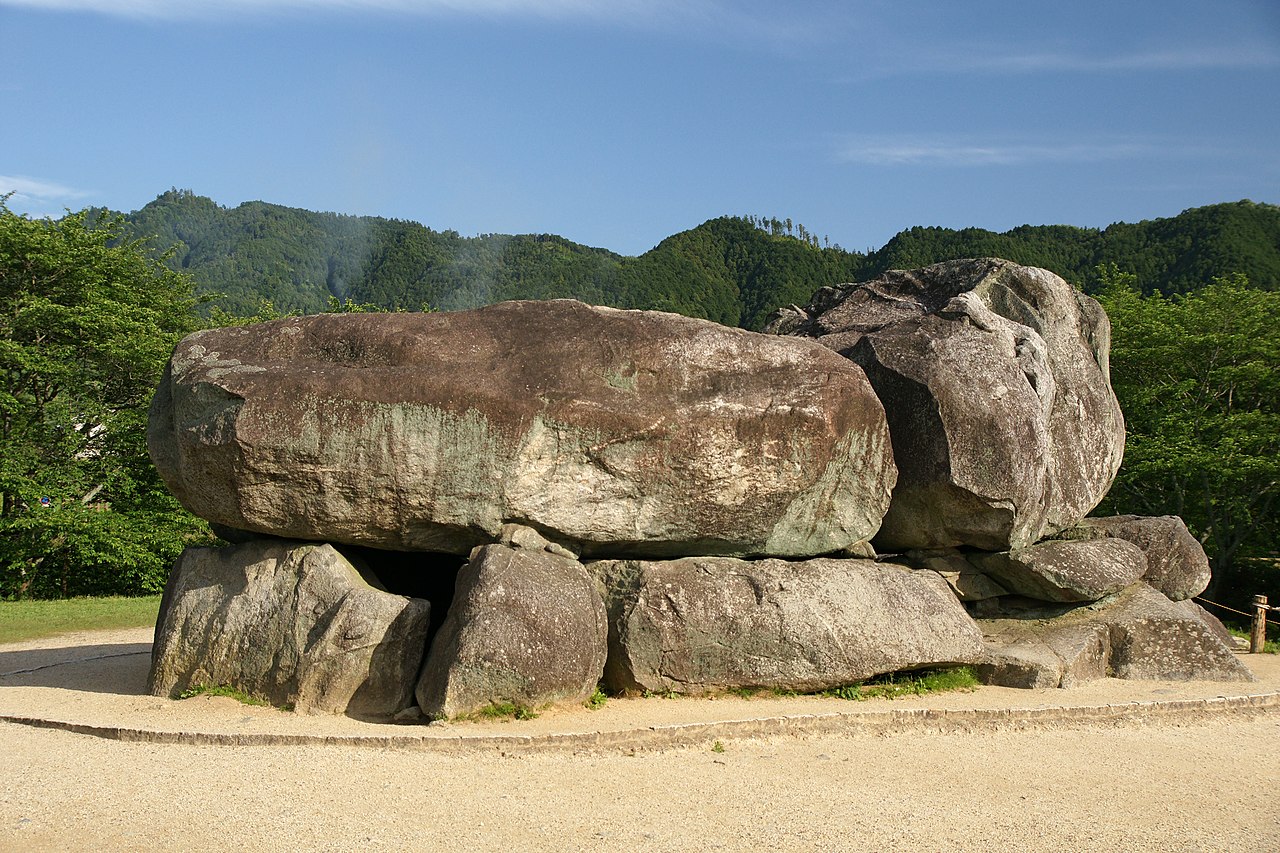
Among the rice paddies and hillside burial mounds of Asuka, a series of enormous carved granite stones stand in positions that have never been satisfactorily explained. They predate the Buddhist temples and imperial tombs that make Asuka famous, and no one knows what they were for.
Masuda-no-Iwafune (“Rock Ship of Masuda”) — A granite monolith roughly 11 metres long, 8 metres wide, and 4.7 metres tall, carved on top with two rectangular holes aligned to no obvious astronomical or architectural purpose. It sits on a hillside with no apparent relationship to any structure. The name “rock ship” comes from its vague resemblance to a vessel from above.
Kame-ishi (“Turtle Stone”) — A carved granite rock resembling a turtle, sitting in a stream bed. Its age and purpose are unknown; it has been in its current position for at least 1,300 years.
Sakafuneishi (“Sake Ship Stone”) — A flat granite slab with carved channels and basins that may have been used for liquid — sake offerings, water divination, or drainage of something unknown. The channels connect but lead nowhere.
The stones are spread across ordinary agricultural land — you find them by cycling between rice fields and occasional road signs. The combination of their scale, their obvious intentionality, and the complete absence of any explanation makes them genuinely strange. Archaeologists have proposed everything from sake brewing equipment to astronomical observation platforms to territorial boundary markers. None of the theories fully fits.
Best visited: On an overcast weekday morning when the light is flat and the fields are quiet. The stones are more interesting when you can stand at them alone.
🌲 Mt. Yoshino — The Yamabushi Mountain After Dark
Access: Yoshino Station (Kintetsu Yoshino Line) — ropeway or 15 min walk to Shimo-Senbon; upper trails continue to Oku-Senbon Entry: Free (trails); ropeway ¥460 one-way Best time: Late afternoon into evening (stay in a Yoshino ryokan overnight)
Mt. Yoshino is famous for cherry blossoms, but its identity as a sacred mountain runs far deeper. For over 1,300 years, Yoshino has been the base for Shugendo — the ascetic mountain practice that combines Buddhism, Shinto, and elements far older than either, involving waterfall standing, cliff hanging, fire walking, and multi-day forest traverses in near-darkness. The yamabushi monks who practise Shugendo still climb Yoshino on specific ceremonial dates, blowing horagai conch shells whose sound carries across the mountain valleys at night.
The trail above Oku-Senbon — the uppermost cherry zone, which during blossom season is itself beyond most visitors — continues into deep mountain forest. The ancient paths to Ominesan (another 10km south) are the routes that ascetic monks have walked for over a millennium, sometimes as a 10-day continuous traverse without shelter.
At night, with the day-trippers gone and the cherry trees dark, Yoshino’s mountain character reasserts itself. The lanterns of the ryokan and temple lodgings glow in the valley. The forest beyond them is complete blackness. From the Zao-do Hall of Kinpusen-ji temple — the wooden doors of which are opened only three days a year to reveal the three enormous hidden Buddha statues inside — the mountain path continues upward into forest that has no lighting, no signage, and no mobile signal beyond a certain point.
The specific legend: The ghost of Emperor Go-Daigo, who fled to Yoshino in 1336 and established the Southern Court here after losing Kyoto, is said to remain on the mountain. His mausoleum at Yoshino’s Nyoirin-ji temple is a small grave marker in the cedar forest, tended but quiet. The emperor who spent his last years as a pretender in the mountains, never returning to his capital, is not an angry ghost — just an unresolved one.
🏘️ Imai-cho at Night
Access: Yamato-Yagi Station (Kintetsu Osaka/Kyoto Lines) — 10 min walk Entry: Free (outdoor townscape) Best time: 18:00–20:00 (after the few visitors have left)
Imai-cho is the best-preserved merchant town in Japan — more intact than any of Kyoto’s famous preserved districts, with over 500 Edo-period buildings still standing along a grid of narrow streets. It survived the 20th century largely because it was never on a main road, never modernised, never bombed. During the day it is a low-key heritage site; after 17:00 it becomes something else entirely.
The town has almost no accommodation and no restaurants that stay open late. By evening, the streets are empty. The Edo-period merchants' houses, many still occupied by descendants of the original families, are lit only by street lanterns and the occasional window glow. The wooden lattice fronts, the kura (warehouse) buildings with thick white plaster walls, and the narrow alleys between them are unchanged from 300 years ago.
The ghost tradition associated with Imai-cho is that of zashiki-warashi — the household spirit children of old merchant families, said to inhabit the oldest buildings and bring fortune to those who host them, misfortune to those who drive them away. Whether or not you believe this, walking the empty streets of Imai-cho after dark through unchanged 18th-century architecture is one of the more disquieting and beautiful experiences in the Nara region.
Getting there: From Yamato-Yagi Station, walk 10 minutes south. The preserved district is clearly marked. No entrance gate, no ticket — you simply enter the streets.
Practical Notes
- Kasugayama Forest: The trail gates close at sunset — check the exact closing time at the Kasuga Taisha reception before entering the upper path
- Asuka by bicycle: Rent at Asuka Station (¥1,000–¥1,500/day, electric assist available). The stone monuments are spread out — 3–4 hours to visit all comfortably
- Yoshino overnight: Staying in a Yoshino ryokan is the only way to experience the mountain after day-trippers leave. Blossom-season ryokan must be booked months ahead; non-blossom season is readily available
- Imai-cho timing: Come as late afternoon transitions to evening for the best atmosphere; no facilities after the few daytime shops close
- The sites in this guide are all publicly accessible and legally open. Do not enter any restricted areas, climb burial mounds, or enter private property


