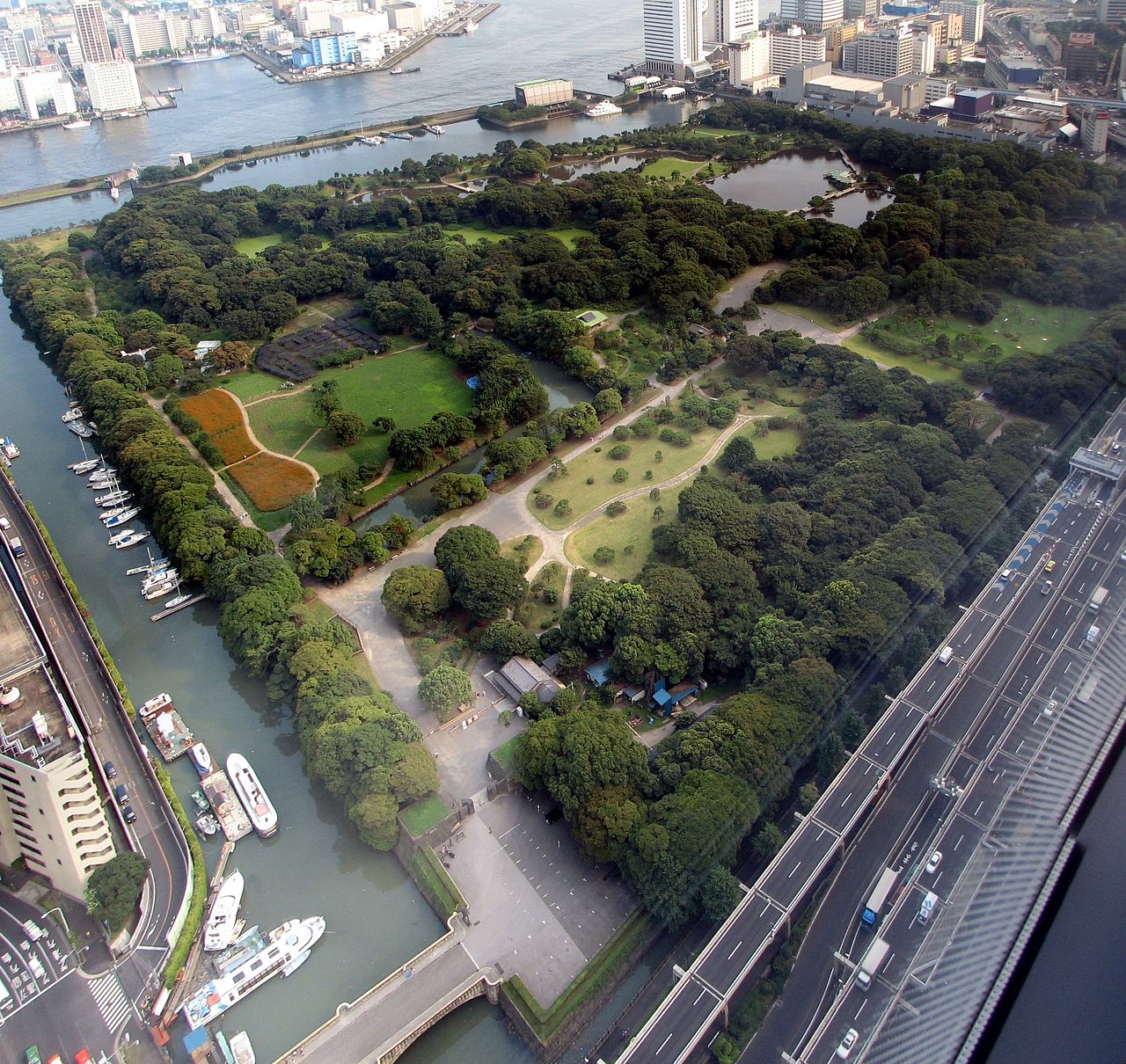
Few places capture the strange beauty of Tokyo like Hamarikyu. Step inside the walls of this 300-year-old feudal garden and you’re surrounded by pine forests, a tidal seawater pond, and a teahouse on an island reached by wooden bridges — while directly behind it all loom the glass skyscrapers of the Shiodome business district. The juxtaposition of Edo-era serenity and 21st-century steel, framed in a single view, is one of the most photographed and most quietly moving sights in the city.
Once a shogun’s private retreat and duck-hunting ground, Hamarikyu is now a tranquil escape beside Tokyo Bay, just a short walk from Tsukiji and Ginza — and the departure point for a scenic river cruise to Asakusa. This guide covers what to see, the tea ceremony, the seasons, and how to combine it into a perfect central-Tokyo day.
🗓️ Quick Reference
| Address | 1-1 Hamarikyu-teien, Chuo-ku, Tokyo |
| Hours | 9:00–17:00 (last entry 16:30) |
| Entry | ¥300 adult (free for children) |
| Teahouse matcha | ~¥850 (matcha + sweet) |
| Nearest stations | Shiodome, Tsukijishijo |
| Time needed | 60–90 minutes |
A Garden with a Shogun’s History
Hamarikyu began in the 1650s as a villa for a branch of the Tokugawa family, built on reclaimed land at the mouth of the Sumida River. It later became a strolling garden and falconry/duck-hunting ground for the shoguns themselves. After the Meiji Restoration it served as a detached imperial palace, and in 1946 it opened to the public. The garden is now designated a Special Place of Scenic Beauty and a Special Historic Site — a rare double honour.
Crucially, the central pond, Shioiri-no-ike, is a genuine tidal pond fed by Tokyo Bay through a sluice gate. Its water level and salinity rise and fall with the tide, an Edo-era design feature that supports saltwater fish and changes the garden subtly throughout the day.
What to See
The Tidal Pond & Nakajima Teahouse
The heart of the garden is the saltwater pond, crossed by elegant wooden bridges to a small island bearing the Nakajima-no-ochaya teahouse. The longest bridge, Otsutai-bashi, is a beautiful 118-metre wisteria-covered structure. The view from the teahouse — pond, pines, bridges, and skyscrapers behind — is the garden’s signature.
The Tea Ceremony
At the floating teahouse you can sit on tatami overlooking the water and be served a bowl of matcha with a traditional sweet (~¥850). It is one of the most accessible and atmospheric places in Tokyo to enjoy matcha in a historic setting — no formal reservation needed, just walk in.
The 300-Year Pine (Sanbyaku-nen no Matsu)
Near the main entrance stands an enormous, sprawling black pine planted around 1709 — one of the largest in Tokyo, its low branches propped on supports. A magnificent living link to the garden’s origins.
The Duck-Hunting Grounds (Kamoba)
Hidden in the garden are the restored duck-hunting blinds and decoy ponds once used by the shoguns — an unusual glimpse into Edo-era aristocratic pastimes, with explanatory signage.
Seasonal Flower Fields
Hamarikyu plants seasonal flower fields that are spectacular in bloom:
- Spring: plum blossoms, then cherry, then a field of bright yellow rapeseed (nanohana)
- Summer: lotus and a stunning field of cosmos
- Autumn: more cosmos and fine foliage
- Winter: plum and peony
The Water Bus to Asakusa — A Scenic Bonus
One of the best things about Hamarikyu is that it doubles as a boat pier. The Tokyo Mizube Line / Sumida River water bus departs from inside the garden and cruises up the Sumida River to Asakusa (about 35–40 minutes), passing under a series of distinctive bridges with the Skytree rising ahead.
This makes a brilliant itinerary: enjoy Hamarikyu’s calm, then board the boat and glide up the river to Asakusa and Senso-ji. The garden admission and boat fare are separate; buy the cruise ticket inside the garden. (Check the current schedule, as services vary by day and season.)
Best Times to Visit
- Early spring (Feb–Mar): plum blossoms, then the golden rapeseed field — a striking contrast against the towers.
- Late summer–autumn (Sep–Oct): the cosmos fields in full bloom.
- Morning: softest light and fewest crowds; the garden opens at 9:00.
- Year-round: Hamarikyu is lovely in every season and rarely overwhelmingly crowded, making it a reliable peaceful stop.
Combining Your Visit
Hamarikyu is perfectly placed for a central-Tokyo loop:
- Tsukiji Outer Market (10 min walk): Seafood breakfast before the garden’s calm — see our Tsukiji guide .
- Ginza (15 min walk): Shopping and dining next door.
- Asakusa & Senso-ji (via the river boat): Take the water bus up the Sumida — see our Senso-ji guide .
- Shiodome & Hamamatsucho: Modern dining and the monorail to Odaiba.
Getting There
- Toei Oedo Line → Shiodome Station, ~7 min walk; or Tsukijishijo Station, ~5 min walk.
- Yurikamome Line → Shiodome Station.
- From Tsukiji or Ginza: a pleasant 10–15 minute walk.
- By boat: arrive or depart via the Sumida River water bus from Asakusa.