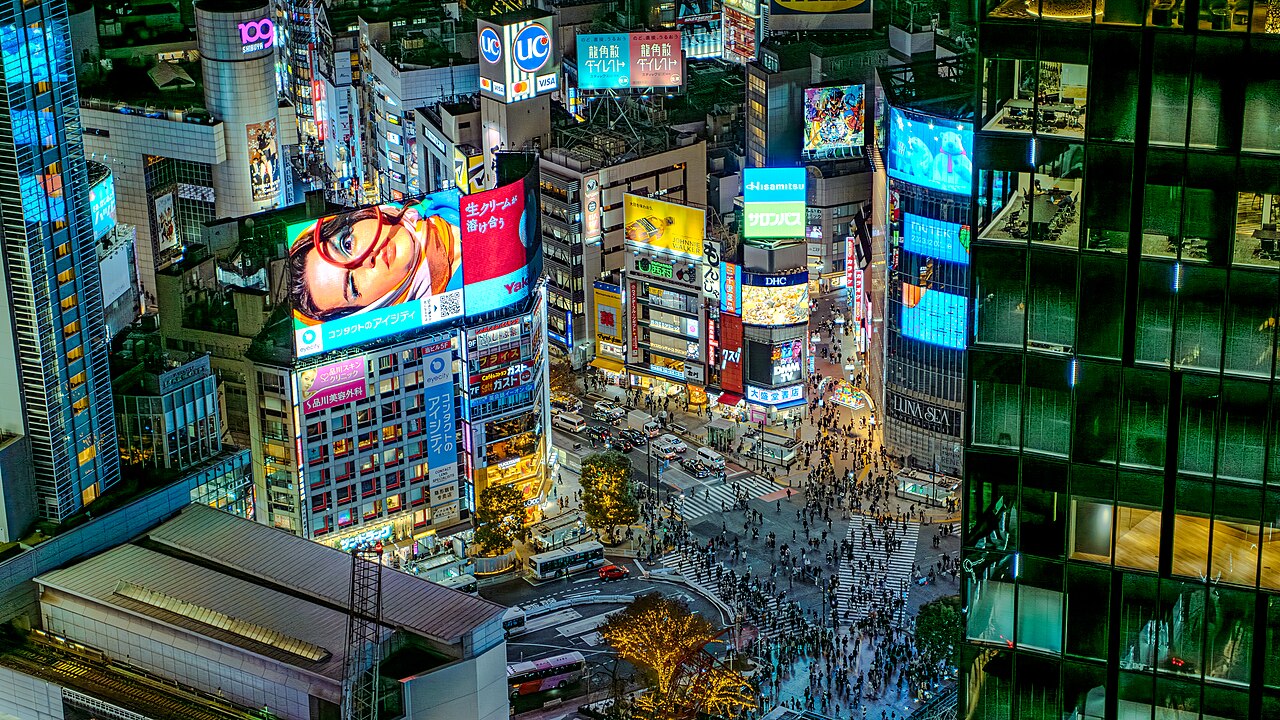
The Shibuya Scramble Crossing is the image that says “Tokyo” more than any other. When the lights turn red in every direction at once, up to 3,000 people surge across from all sides simultaneously beneath a blaze of giant video screens and neon — and somehow nobody collides. It happens again every couple of minutes, all day and late into the night. Watching it, and crossing it yourself, is a rite of passage on any first visit to the city.
But Shibuya rewards those who look at it from more than one angle — literally. This guide covers the crossing at street level, the best free and paid viewpoints above it (including the spectacular open-air Shibuya Sky), the story of the Hachiko statue, and exactly when to come for the full effect.
🗓️ Quick Reference
| Location | Shibuya Station Hachiko exit, Shibuya-ku, Tokyo |
| Crossing | Free, 24 hours |
| Shibuya Sky (rooftop) | ~¥2,500 advance / ~¥3,000 door, 229 m |
| Shibuya Sky hours | 10:00–22:30 (last entry 21:20) |
| Nearest station | Shibuya (JR, Metro, Tokyu, Keio — many lines) |
| Best time | After dark, when the screens and neon are lit |
The Scramble Crossing at Street Level
Step out of Shibuya Station’s Hachiko exit and you’re right at the edge of the crossing. The experience of standing in the middle as a thousand people flow around you — phones up, screens glowing overhead — is the essential one. Cross it once just to feel it, then step back and watch a few cycles from the edge.
A note on etiquette: The crossing is a working intersection used by tens of thousands of commuters. Keep moving while crossing, don’t stop in the middle for long photo sessions, and film from the edges or from above rather than blocking foot traffic.
The Best Viewpoints Above the Crossing
The crossing is even more mesmerising from above, where you can see the full geometric pattern of the human flow. From free to premium:
1. Starbucks (Shibuya Tsutaya) — Free (buy a drink)
The second-floor Starbucks in the QFRONT/Tsutaya building overlooks the crossing through floor-to-ceiling windows and is the classic, free-ish vantage point (you buy a coffee). The catch: it is extremely popular, window seats are fiercely contested, and the building has been undergoing redevelopment — check its current status. When open, arrive off-peak and be patient.
2. Mag’s Park Rooftop (Magnet by Shibuya 109) — Cheap
The “Crossing View” rooftop terrace of the Magnet by Shibuya 109 building offers a direct, elevated look straight down onto the crossing for a small fee. This is the best-value dedicated crossing viewpoint and a favourite for that classic top-down photo.
3. Shibuya Station / Hikarie & connecting walkways — Free
The elevated walkways and the windows of the station complex and Shibuya Hikarie offer free partial views and are worth a look as you pass through.
4. Shibuya Sky — Premium (the showstopper)
For the ultimate perspective, Shibuya Sky is the open-air rooftop observation deck atop Shibuya Scramble Square at 229 metres. See the dedicated section below.
Shibuya Sky: The Open-Air Rooftop
Shibuya Sky is, for many travellers, the best observation experience in Tokyo — not because it’s the highest (it isn’t), but because the top level is open-air. Standing at the rooftop edge with the wind and the whole city laid out below, the famous crossing reduced to a tiny pulsing pattern far beneath you, is unforgettable, especially at golden hour.
What to expect:
- 14th–45th floors via escalators and a transition zone, then the rooftop “Sky Stage” at 229 m
- A 360° open-air panorama; on clear days, Mt. Fuji to the west
- The “Sky Edge” corner for that edge-of-the-world photo
- Hammock-like nets and a “Cloud Hammock” to lie back on
- An indoor level (Sky Gallery) for poor weather
Tickets & timing:
- Book advance, date-and-time-specified tickets online — sunset slots sell out days ahead
- The sunset / blue-hour slot (arrive ~45 min before sunset) is the single most rewarding and the hardest to get
- Security note: loose items and large bags must be stored in lockers before going to the open-air roof (for safety at height); phones with a wrist strap are allowed
Shibuya Sky vs. Tokyo Skytree: The Skytree is far higher (350/450 m) and better for Mt. Fuji and sheer scale; Shibuya Sky is lower but open-air, central, and gives you the iconic Shibuya Crossing from directly above. See our Skytree guide to compare.
The Best Time to Come
- After dark is when Shibuya is at its most cinematic — the giant screens, the neon, the rivers of people. Roughly 7–10 pm on a Friday or Saturday is peak intensity.
- Golden hour at Shibuya Sky: Arrive ~45 minutes before sunset for the day-to-night transition from the rooftop.
- Rain, surprisingly, can be magical at street level — umbrellas and reflections on the wet crossing make for striking photos (though Shibuya Sky’s open roof closes in bad weather).
The Hachiko Statue
Just outside the Hachiko exit stands the bronze statue of Hachiko, the Akita dog who waited at Shibuya Station every day for his deceased owner for nearly ten years until his own death in 1935. The story is Japan’s most beloved tale of loyalty. The statue is a famous meeting point — and consequently almost always surrounded by people and a small photo queue. It’s a brief but meaningful stop; expect to wait a moment for a clear shot.
Around the Crossing
Shibuya is a full district, not just an intersection:
- Shibuya Scramble Square — the skyscraper housing Shibuya Sky, with shopping and dining below
- Center Gai — the pedestrian street of shops, arcades, and cheap eats running off the crossing
- Shibuya 109 — the iconic cylindrical fashion building for youth style
- Miyashita Park — a rooftop park atop a shopping complex, good for a break
- Nonbei Yokocho (“Drunkard’s Alley”) — a tiny lane of miniature post-war bars, a characterful contrast to the giant screens
Getting There
Shibuya Station is one of Tokyo’s largest hubs, served by the JR Yamanote, Saikyo, and Shonan-Shinjuku lines, the Tokyo Metro Ginza, Hanzomon, and Fukutoshin lines, and the Tokyu and Keio private lines. Follow signs to the Hachiko exit for the crossing and statue. The station is famously labyrinthine and under long-term redevelopment — allow extra time and use the abundant English signage.