There are two ways to see sumo in Tokyo. One is to attend a Grand Tournament (honbasho) — the great public spectacle of ceremony, salt-throwing, and roaring crowds held in Tokyo three times a year. The other is far more intimate and far less known: watching the morning training session (keiko, 稽古) at a sumo stable, where wrestlers practise in near silence, often just a few metres from a small group of guests sitting on cushions.
The morning practice is the closest an outsider can get to the actual world of sumo — a world that is otherwise almost entirely closed. The wrestlers live, eat, sleep, and train at the stable (heya, 部屋), governed by a hierarchy and a discipline that has changed remarkably little in centuries. For the visitor who approaches it with the seriousness it demands, watching keiko is one of the most memorable cultural experiences available in Tokyo.
🗓️ Quick Reference
| What | Morning training session at a sumo stable |
| Where | Mostly Ryogoku district, Sumida-ku, Tokyo |
| When | Mornings, typically 6:00–10:00 (varies by stable) |
| Cost | ¥5,000–15,000 per person (via tour/agency) |
| Booking | Required, in advance — never just turn up |
| Duration | 1.5–3 hours of observation |
| Available | Only when no tournament is running and stable is in Tokyo |
Stable Visit vs. Tournament: Which Is Which?
It’s important to understand the difference before booking.
| Grand Tournament (Honbasho) | Morning Practice (Keiko) | |
|---|---|---|
| Atmosphere | Loud, ceremonial, public spectacle | Silent, intimate, private |
| Crowd | 11,000 spectators | 5–30 guests |
| When (Tokyo) | January, May, September | Most other times |
| What you see | Ranked bouts, ceremony, top wrestlers | Raw training, all ranks, up close |
| Tickets | Public sale, ¥3,800–14,800+ | Private booking via agency |
| Distance | Stadium seating | A few metres away |
The two experiences are complementary, not competing. If your trip coincides with a tournament, attend that. Morning practice is what you do when there’s no tournament running — and many would argue it’s the more profound experience.
Why You Must Book in Advance
Sumo stables are private residences and workplaces. Wrestlers are training seriously, not performing for tourists. Historically, some stables permitted respectful members of the public to observe quietly with prior arrangement, but walking up uninvited is unacceptable and increasingly stables have closed entirely to casual visitors due to past disrespectful behaviour.
For overseas visitors, the practical and reliable route is to book through a tour operator or experience agency that has an established relationship with a specific stable. These tours:
- Arrange permission with the stable in advance
- Provide an English-speaking guide who explains what you’re watching
- Brief you thoroughly on etiquette before entering
- Ensure the stable is compensated and the relationship stays respectful
This is one case where booking a guided experience rather than going independent is genuinely the correct approach — both practically and ethically.
Where to book: Search “Tokyo sumo morning practice tour” on Viator, GetYourGuide, Klook, or Airbnb Experiences. Reputable operators run small-group keiko visits for ¥5,000–15,000 per person.
The Strict Etiquette Rules
Sumo training is conducted with intense seriousness and is bound up with Shinto ritual purity (the dohyo training ring is a sacred space). Breaking etiquette is not a minor faux pas — it can result in being asked to leave, and damages the stable’s willingness to host future visitors. The standard rules:
Absolute rules:
- Silence. Do not talk during training. Whisper only if essential. The session is conducted in near-total quiet apart from the sounds of training itself.
- Do not point your feet at the dohyo. Sit cross-legged or kneel (seiza). Pointing the soles of your feet at the sacred ring is disrespectful. If your legs cramp, shift discreetly.
- No flash photography. Photography is often allowed (confirm with your guide), but never with flash, and never when it disrupts.
- Do not stand or move around. Stay seated where you are placed for the duration.
- Switch phones to silent. No calls, no ringing, no loud notifications.
- Do not eat or drink during the session unless told it’s permitted.
Dress and conduct:
- Dress modestly and respectfully (no beachwear, neat casual is fine)
- Arrive on time — latecomers disrupt the session and may not be admitted
- Remove shoes when entering (you’ll sit on a tatami or cushioned viewing area)
- Follow every instruction from your guide and the stable staff without question
The underlying principle: You are a guest in someone’s home and workplace, observing a serious professional and spiritual discipline. Behave accordingly.
What You’ll Actually See
Morning keiko follows a structured progression that intensifies over the session.
Shiko (四股): The iconic leg-stomping exercise — wrestlers raise each leg high and stamp it down, a warm-up that builds balance and strength and ritually drives evil from the ring. You’ll see endless repetitions.
Suriashi (摺り足): Sliding-foot movements across the ring, training the low, stable posture fundamental to sumo.
Teppō: Striking a wooden pillar (teppō pole) with open palms — conditioning the hands and practising the thrust attacks (tsuppari).
Matawari: Extreme flexibility training — wrestlers do front splits and press their chests to the ground, often with senior wrestlers pushing them down. The flexibility of these large men is startling.
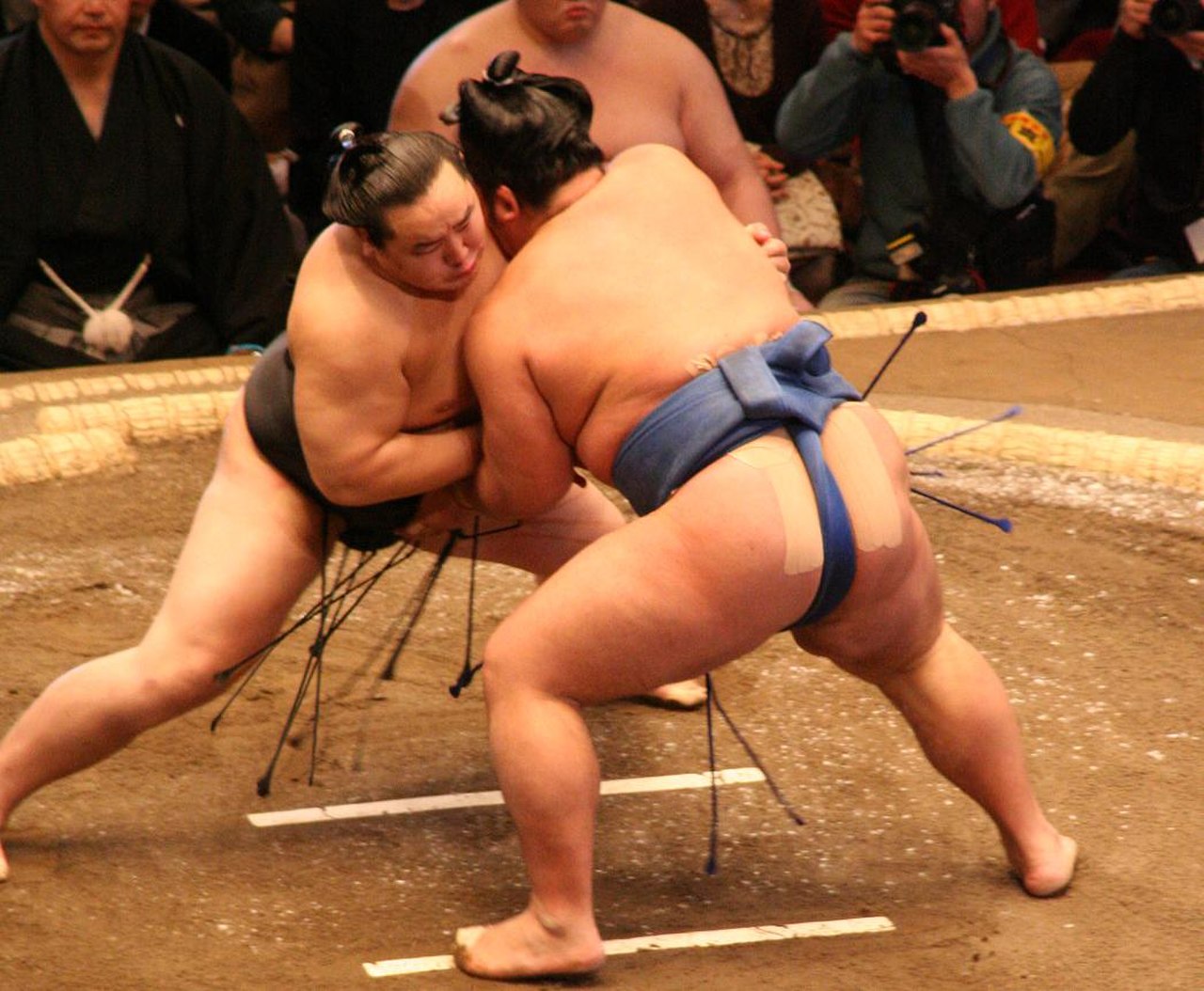
Moshiai / Bouts: The heart of the session — wrestlers face off in practice bouts. The winner stays in the ring and faces the next challenger, sometimes for dozens of consecutive bouts. This continuous-challenge format (moshiai-geiko) means the strongest wrestlers train hardest. The intensity, the impact of the collisions, and the raw effort at close range are unforgettable.
Butsukari-geiko: A grueling drill where one wrestler repeatedly charges into another who absorbs and pushes back, driving the attacker across the ring again and again until exhausted. This is the most physically punishing part of training and often where the emotional intensity peaks.
Throughout, the stablemaster (oyakata, a retired wrestler) watches, occasionally correcting. The hierarchy is visible everywhere: junior wrestlers also do the cleaning, preparation, and serving; senior wrestlers train and are attended to.
After Practice: The Ryogoku Sumo District
The morning visit pairs naturally with exploring Ryogoku, the historic heart of sumo in Tokyo.
Ryogoku Kokugikan (National Sumo Stadium): The 11,000-seat arena that hosts the three annual Tokyo tournaments. Even outside tournament season, the Sumo Museum inside (free entry) displays historical artifacts, ceremonial aprons (kesho-mawashi), and portraits of past grand champions (yokozuna).
Chanko Nabe lunch: Chanko-nabe is the protein-rich hot pot that wrestlers eat to build mass — a communal pot of chicken, fish, tofu, and vegetables. Several restaurants in Ryogoku, many run by retired wrestlers, serve it to the public. After watching the training that builds these athletes, eating their staple meal is a fitting conclusion. Expect ¥1,500–4,000 for a generous portion.
Edo-Tokyo Museum area: The neighbourhood also holds the Edo-Tokyo Museum (check reopening status) and a generally traditional, low-rise atmosphere distinct from central Tokyo.
When It’s Available
Morning practice visits are only possible when:
- No tournament is running. During the three annual Tokyo tournaments (January, May, September), and during regional tournaments and tours when stables travel, keiko visits do not run.
- The stable is in Tokyo. Stables sometimes travel for regional tours (jungyo).
This means availability is essentially “most mornings outside tournament months,” but it varies. Book through an agency that confirms a specific available date rather than assuming.
Getting There
Ryogoku Station:
- JR Sobu Line — Ryogoku Station, west exit
- Toei Oedo Line — Ryogoku Station, A4 exit
Most stables are within walking distance of Ryogoku Station, though some are in other parts of Tokyo. Your tour operator will provide the exact meeting point — always confirm the location, as not all stables are in Ryogoku.
Timing: Practice starts early (often 6–7am). Factor first-train timing if coming from elsewhere in Tokyo. Your tour will specify a meeting time; arriving late is not an option.